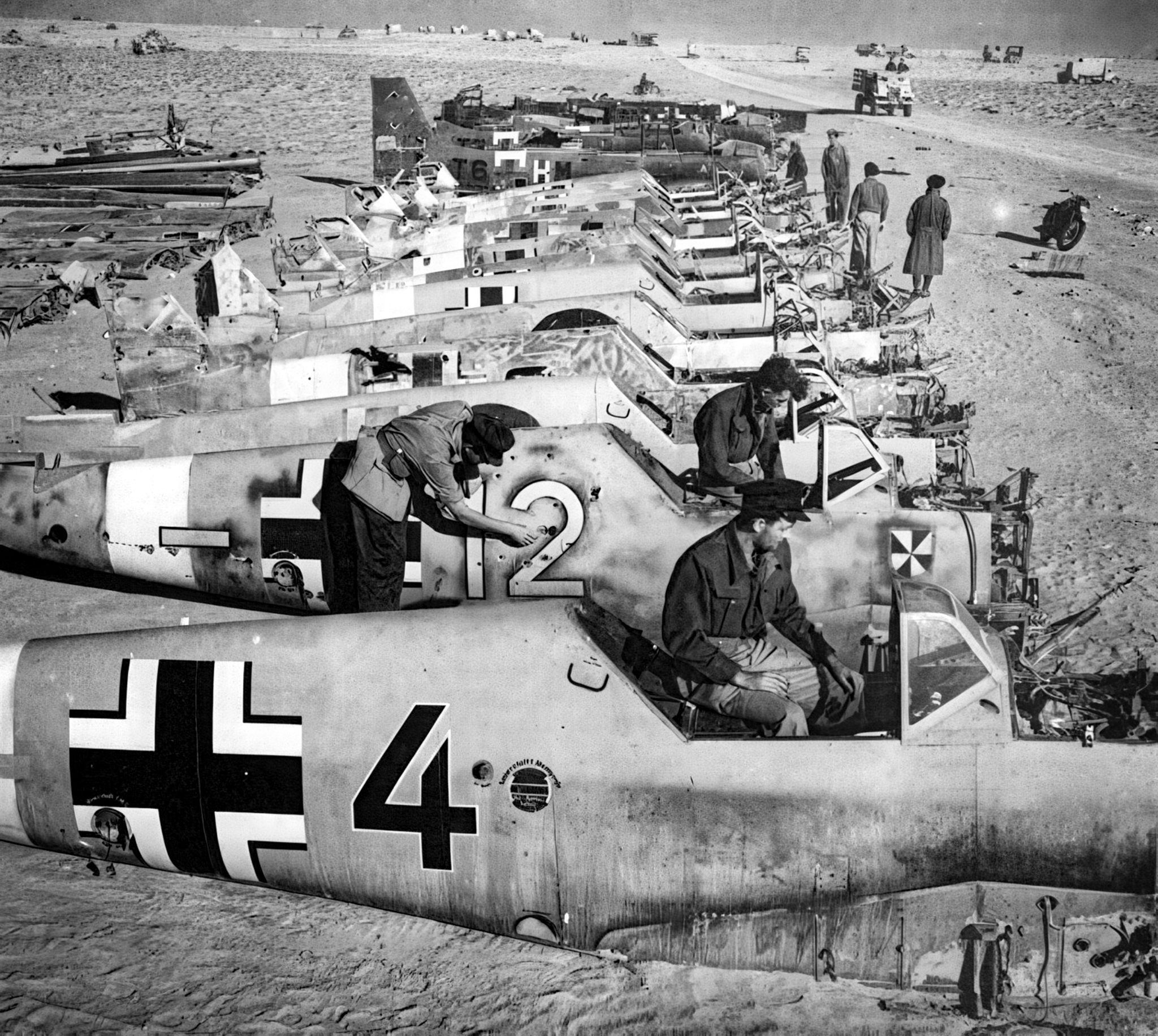

I talked about this at length with my friend, the #3 German ace and 109 pilot, Gunther Rall, and it was a bit of a slippery question and we never quite got to the bottom of it, at least to my satisfaction.
He personally flew Bf 109s and absolutely loved them, even in the face of the markedly superior Fw 190 and the even sterner face of Allied fighters that could outperform the 109s, but had no problem flying them till his last combat in ‘44. But the reason Germany never really embraced another fighter design they way they had the Bf 109, but stayed with that old and tired design till the end was and is complete freakin’ mystery to me, and apparently to Rall, too.
(Above: The very fast Bf 109K right at the end over Berlin. Finally a speed match for the Spitfires, P-51s and P-47s…except there was no fuel, no trained pilots, and many of the Ks were strafed on the ground.)
Some say the Bf 109 was actually never outdated, that it continued to shoot down enemy aircraft till the end and was good enough, so why change a good thing/”if it ain’t broke dont fix it.” Yeah, that’s what they said about the A6M Zero, too. Even Rall, who worshipped it was honest enough, (as his life depended on it,) to understand it had run out of steam by 1941 and an update would be very welcome. But the Luftwaffe pilots were blind to a lot of things, couldn’t see the forest for the trees, the 109s being part of that, and their insane “training program’ where they didn’t rotate experienced pilots back to train but embraced “Victory or Death” in a true death cult fashion.
The Fw 190 was an entirely different machine and flew entirely differently, too. A full ton heavier than the 109, the Fw 190 had features the 109 could only dream of: A far tougher air-cooled radial engine making 500 (and more) greater horse power, the best roller of WWII, a bit better diver, far greater firepower, far tougher with its air-cooled BMW 801 radial, Duraluminum fuselage and one-piece wings, far higher cockpit with better visibility, far easier to maintain, infinitely better and safer landing gear than the 109’s criminal and murderous monstrosity. And the Fw190 was far more versatile, working very well as a ground attack ship from her strength and air-cooled engine.
But it didn’t perform well at high altitude where the American bombers streamed, (Addressed by Kurt Tank with the Fw 190Dora model,) and you couldn’t whip it around the sky like a well experienced pilot in his Bf 109. The Bf 109 was a “racehorse” and the Fw 190 was a “workhorse.”
The Bf 109 was a bit like the smaller American “racehorse,” the P-51 Mustang, and the Fw 190 was a bit like the bigger “workhorse,” the P-47 Thunderbolt. And the Old Corps of Luftwaffe pilots preferred the nimble “racehorse” they had trained in, gained their experience in, won their victories in. I believe in some ways the older Luftwaffe pilots resisted any changes that weren’t a true update of their beloved Bf 109.
Some say that the time and effort to retool for a new fighter would have hit the Luftwaffe hard, but I don’t believe that as Germany retooled and upgraded old machine and came out with new ones through the war.

In a total war, you can usually fid ways to get done what needs to get done. When Germany was making the Panzer III, they retooled some, took off the turret and produced the assault guns, and when they phased out the Panzer III completely, they were able to quickly produced far more StuG IIIs, with very little wasted time.
Here’s a couple of other partial answers:
In a case of “Mom liked you best” Hitler clearly had a love affair going with Willy Messerschmidt from their long years of association and how Willy gave Hitler the very good Bf 109 back in 1937. Kurt Tank, a far better designer, test pilot was simply too honest, too brutal to get along with Hitler. Hitler could be completely swayed by a hearing exactly what he wanted to hear, and a compliment or two thrown in didn’t hurt. Hitler was also a “paper war gamer,” and “numbers” crazy, wanting large numbers of everything on paper to “play with”: troops, divisions, Tiger and Panther tanks, aircraft. Willy gave him almost 34,000 Bf 109s and he liked that. It made him feel secure.
(Above: Hitler’s the one with the mustache and funny hat. Willy’s just to the left with male pattern baldness.)
The long promised Messerschmidt replacement fighters for the Bf 109, the Me 209 and Me 309, never worked and time and millions of Reichsmarks given to Messerschmidt to make them work was in vain.
(Above: M2 209 prototype of 1943, 4 made, and the program was quickly shut down when it was found it was 50 km/h (31 mph) slower than the Fw 190D and offered no improvement in handling characteristics.)
(Above: Begun in mid-1940 and worked on till mid ‘43, as the smartest at Messerschmidt and the Luftwaffe had already seen how tired the Bf 109 was becoming, and how dangerous the Spitfire was, the Me 309 was to be the replacement for the Bf 109, but didn’t pan out.)
Although it had many advanced features like a tricycle gear and pressurized cabin, the Me 309’s performance left a lot to be desired and it had so many problems that the project was cancelled with only four prototypes built. Only 50 km/h (30 mph) faster than a standard Bf 109G, the Bf 109G could out-turn Me 309. With the addition of armament, the aircraft’s speed decreased to an unacceptable level, and the tremendous performance of the Fw 190 sealed its fate.
It was partially revived in an idea of a new Zerstörer (destroyer) to replace the Bf 110, in an attempt to save time, money and parts, reuse the 309s and piece them together. A version with six Mk 108 30mm cannons was planned, and a night fighter but it took so much time the Me 262 overtook it.
At the end of this meandering answer, I guess I really can’t tell you why Germany didn’t try harder to replace the aging Bf 109. Sorry. They were churning Bf 109s out like hot cakes, (well, for Germany), and it must have been easier just to keep the production lines going.