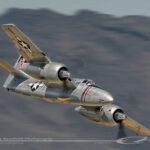
“Corky” Meyer, Grumman’s top test pilot in WWII and Korea said it flew like a dream…except:
…in the spin: when attempting the normal Navy SR-38D spin demonstration requirement of five turns, both directions, it recovered waaay too slowly. The NACA spin tunnel showed the F7F was unrecoverable in the spin after four turns. A test pilot died “confirming” those numbers, to “Corky”’s heartbreak. The Navy then changed its requirements to “All spins and snap rolls are prohibited in the F7F aircraft,” in the official pilot’s manual.
This is part of why it was first sent to land-based Marine units and just barely missed WWII but did fight in Korea.
It also had issues with carrier duty, too: it was too large for even the hanger decks of the big Essex-class carriers, (however its size did help the Navy get ready for all the big tricycle geared jets that were on the way.)
And got folding wings.
The initial Grumman design did not provide sufficient strength to the wing/fuselage attachment near the arresting hook area and a few early F7F’s broke their wings during landing at that place and had to be strengthened.
Because of its great speed, weight and low-drag design it dived very quickly to 525 mph and suffered with the same compressibility issues the P-38 and P-47 had. These two had eventually been given electric dive flaps and Mach instruments, and they were also given to the Tigercat in testing, although their position beneath the wings had to be altered while testing.
The Tigercat was a fav of all the pilots who flew her…provided you didn’t try to “take her for a spin.”