
With the defeat of the Germans and Italians on Sicily in mid-July 1943, the focus of the war in the air shifted toward the battle for the Italian mainland itself. This campaign took place in the context of the coming invasion of northwest Europe.
Filled with personal accounts of the action, Thomas McKelvey Cleaver’s book Mediterranean Sweep The USAAF in the Italian Campaign details the US Army Air Forces‘s tactical and strategic campaigns in the skies over Italy in World War II.
The book also provides a detailed the description of Mount Vesuvius’s last eruption.
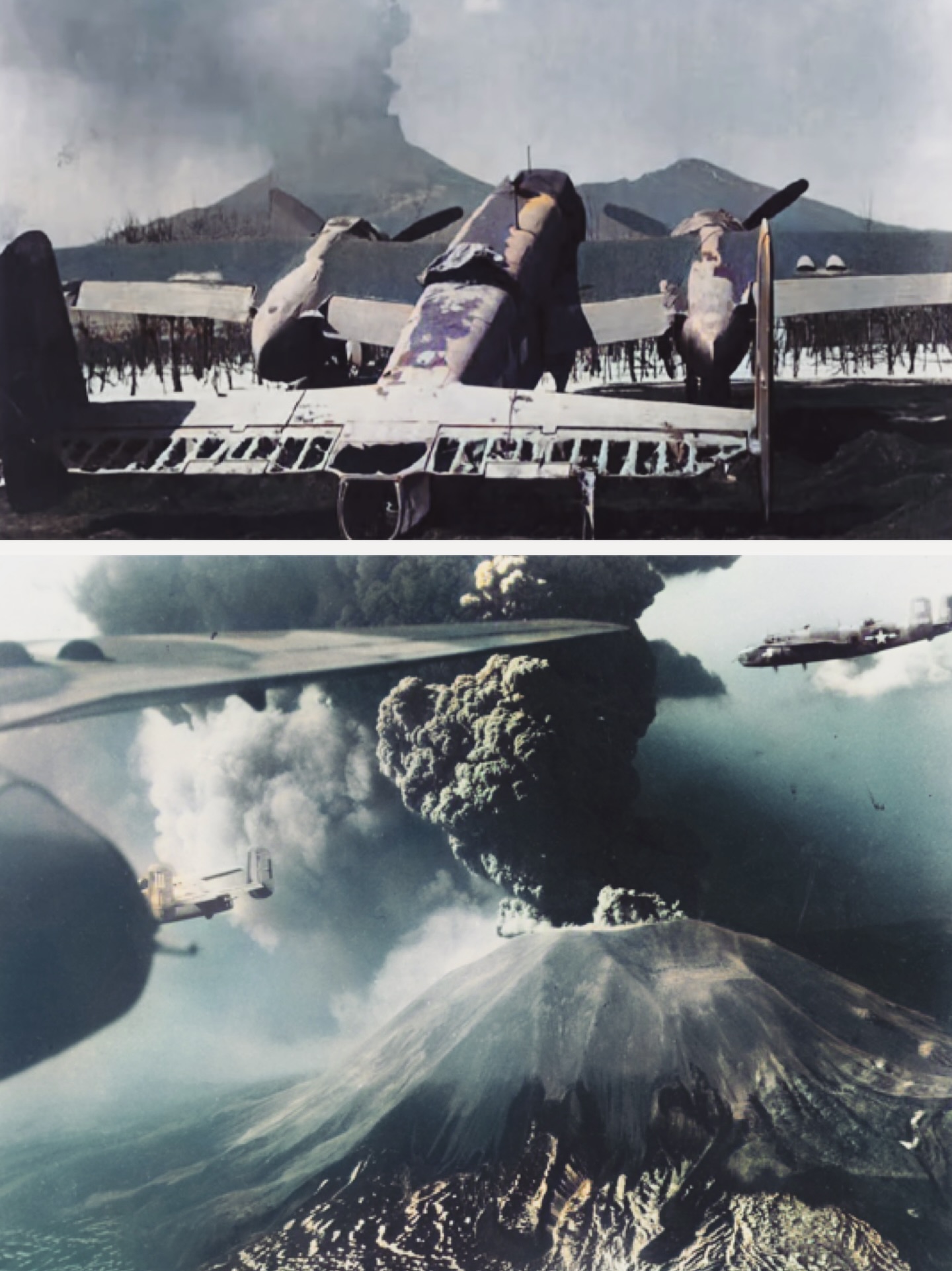
As the fighting continued, the evening of Saturday, Mar. 18, 1944, was quiet and cold, though not freezing. The twilight sky was partially overcast with the promise of rain; the new moon, visible through a break in the clouds, cast a faint light over 88 B-25s of the 340th Bomb Group lined up at Pompeii airfield, near Terzigno, Italy, just a few kilometres from the eastern base of the Mount Vesuvius volcano; light drizzle spattered the bombers.
Suddenly, a distant, growling rumble came from the south, growing in intensity; momentarily, the ground shook. Then shook again. And again, stronger each time. In a minute, the rumble became a continuous, growing roar.
Huge red streams of lava
Flight surgeon Dr Leander K. Powers wrote later in his diary: “While we were just finishing supper, someone called to say there were huge red streams of lava flowing down the sides of Mount Vesuvius. It was a sight to behold. Never had we seen such. As we watched the streams, like giant fingers flowing down the sides, we could see a glow in the sky.”
The next morning, the 486th Squadron’s First Lieutenant Dana Craig sat next to his ruined barracks and wrote a description of the first eruption of Mount Vesuvius in 150 years:
‘About midnight, I went out of my billet to answer the call of nature. While outside, in a mild drizzle, I was hit on the head by what I thought was a small rock. Suspecting some sort of joke, I went inside for a flashlight. When I returned, the light revealed a layer of damp cinders on the ground. We began to feel the earth shake as though a bomb had gone off. After each quake, a few minutes would pass before the debris blown out of the crater would hit the ground. We quickly understood that Vesuvius was erupting. About daylight, the rear of our building started to cave in. We then began to see larger rocks coming down. By this time everyone was wearing his steel helmet and heavy sheepskin flying jacket for protection from the falling rocks.’
A two-week-long series of eruptions

At Foggia, 90 kilometers north of Pompeii, men of the 321st Bomb Group gaped at the sky. A column of smoke and ash rose high in the southern sky. Within hours, smoke and ash descended on the base. By midday, the men had to use goggles to keep ash out of their eyes. That evening, Dr Powers recorded: “All during the night and Sunday there were quakes of the earth with tremendous roars similar to thunder from Vesuvius. The windows rattled, and the entire building vibrated.”
A two-week-long series of eruptions began Mar. 18. The mountain had “acted up” since the beginning of the month, so the only surprise was exactly when it began. Rocks as big as grapefruit fell from the sky, smashing cockpit canopies, plastic gun turrets and bombardier “greenhouses.” The B-25s were dented worse than they had been back at Columbia Army Air Base in South Carolina in late 1942 when the 340th’s entire fleet of 18 bombers was destroyed by a winter hailstorm. The Mitchells were covered in hot ash that burned away the fabric-covered control surfaces and crazed, melted, and cracked the Plexiglas turrets, canopies, and bombardier’s greenhouses. Volcanic ash seeped through openings, filling the bombers and tipping them on their tails.
Mount Vesuvius Eruption destroys 88 B-25 Mitchells
Dr Powers recorded, “The roars became more frequent and grumbled like a lion’s roar. Streams of fire were shooting thousands of feet into the air, and the countryside was lit up for miles around. Oft times the entire top of the mountain looked as if it were a blazing inferno. It’s really uncanny, yet amazing to look at this phenomenon. The vibrations of the building were truly uncomfortable.”
The rain of volcanic ash continued.
By Friday, Mar. 23, as the video in this post shows, Vesuvius had inflicted more damage on the 340th than had the Luftwaffe since their arrival in North Africa 18 months earlier, destroying all 88 B-25s. Unlike the eruption in ad 79, no lives were lost at Pompeii airfield. But for the rest of the month, the skies across southern Italy were colored dull gray by ash and smoke that fell as far north as Rome. Between March 23 and 26, the 340th relocated to nearby Paestum airfield. American aircraft production was such that the total loss in the 340th was made good within a week as new, silver B-25Js arrived to replace the war-weary camouflaged B-25C and D models left behind at Pompeii.