
The 2,000-year-old Roman bath located in Sarıkaya, a district of Türkiye’s Yozgat, stands out as an exceptional example of Roman architecture preserved in Anatolia. This bath, with its well-preserved thermal structure, is one of the few ancient thermal baths still existing today.
The Basilica Therma Roman Bath, known as the ‘King’s Daughter’ (Turkish: Kral Kızı Hamamı or Sarıkaya Roma Hamamı) is an ancient Roman spa town located in the Yozgat province of Turkey.
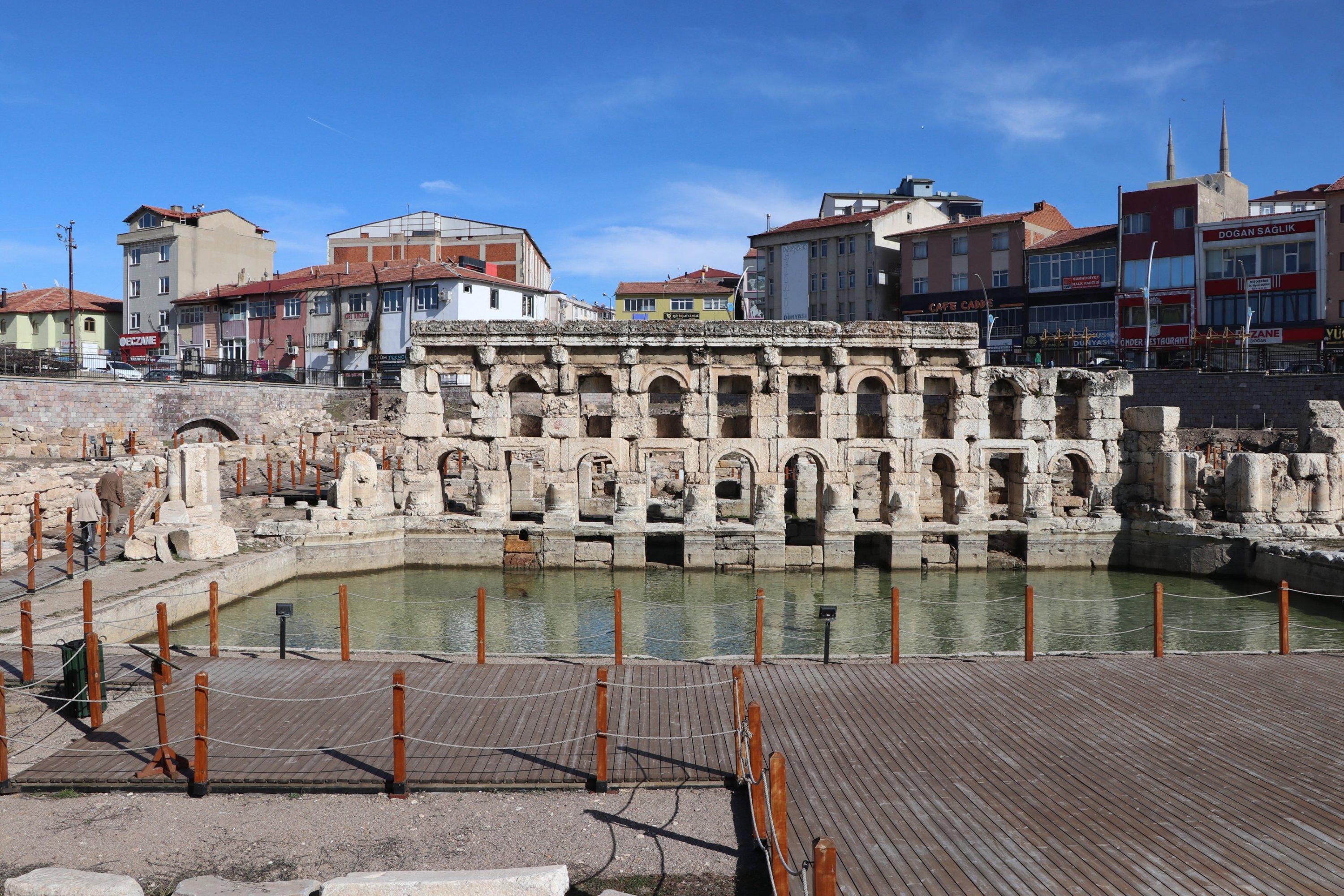
In 2018, the Roman Bath was included in the UNESCO World Heritage Tentative List. Following extensive landscaping and restoration works carried out by the Ministry of Culture and Tourism’s General Directorate for Cultural Heritage and Museums, the goal is to increase its accessibility to a wider audience and contribute to local tourism. With additions such as cafes, souvenir shops and walking paths, the design aims to blend the past with the present, ensuring that the structure welcomes visitors throughout the year.
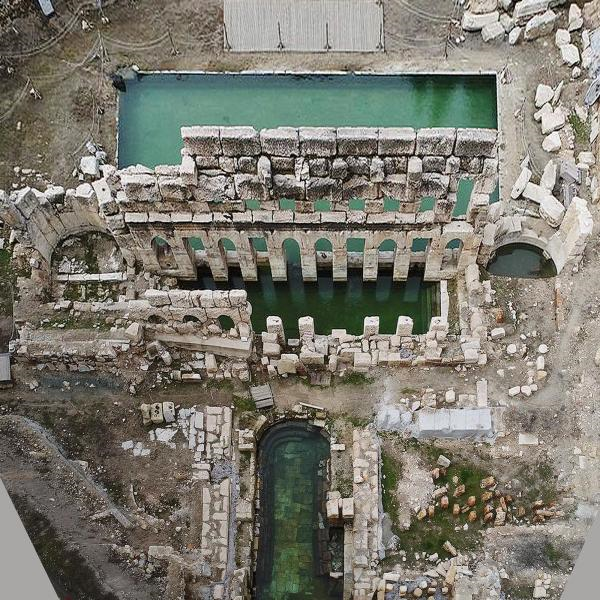
Cihat Çakır, the director of the Yozgat Museum, emphasized that the Sarıkaya Roman Bath is one of the most significant historical and tourist sites in Yozgat. “The bath was commissioned by Antoninus Pius, one of the ‘Five Good Emperors’ of Rome, during the A.D. second century. It consists of three pools: a large one in the front and two smaller ones in the back. In 2018, the bath was added to the World Heritage Tentative List. Restoration and landscaping works were supported by our Ministry of Culture and it was officially opened to visitors,” Çakır explained.
One of two in the world
Çakır further elaborated on the unique features of the historic structure, stating, “One of the remarkable aspects of the Roman bath is that there are only two such baths in the world. The other one is in London. The water in this bath is thermal and is known for its healing properties. During the Roman period, it was called Aquae Sarvenae and during the Byzantine period, it was known as Basilica Therma. The bath continued to be in use not only during the Roman and Byzantine periods but also during the Anatolian Seljuk and Ottoman periods. It remains an essential historical asset for Yozgat, with much of its architecture still intact. The fact that only two such baths exist worldwide is significant for us.”
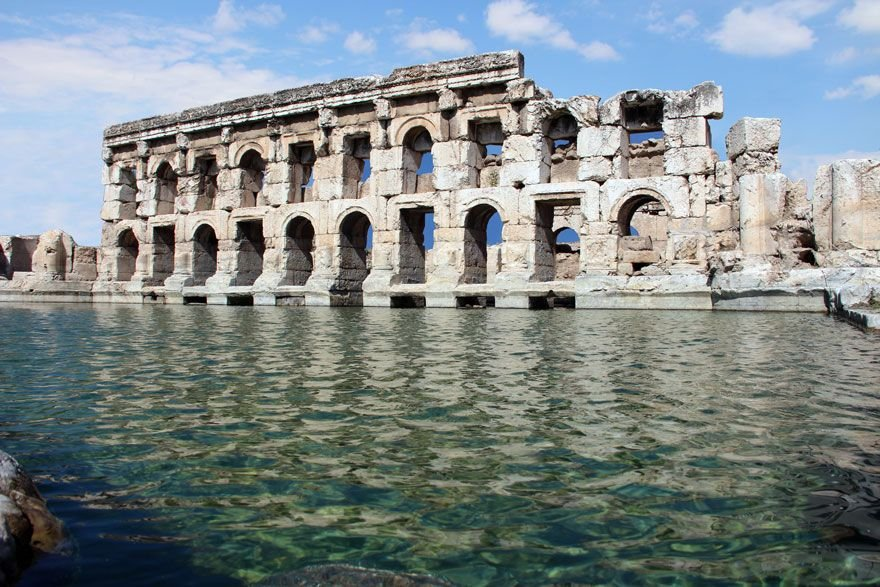
The bath was built in the 2nd century and used in Byzantine, Selcuk and Ottoman periods and still open to the public in modern Turkey.
The large thermal pool measures 23,30×12,80 meters and has a depth of 1.34 meters. Pool water is about 45°C. There is an inner pool measuring 16.00×4.00 meters with symmetrical ladders on its both sides.
The third pool with thermal water boiling from the floor is positioned perpendicular to the inner pool. The pool is 15.00×5.20 meters with a semi-circular shape on its short sides.
In addition to its historical and architectural features, the water of the Roman Bath, which draws attention with its healing water flowing for 2,000 years, dried for the first time this year.
Τhe disappearance of the thermal water, which has been uninterrupted for 2,000 years in the Roman Baths, for the first time this year, and the fact that the ancient pools remained empty for about 4 months started to worry the people of the district.
The fate of the thermal water, which is estimated to have disappeared in recent years due to the dry season and geological reasons in Yozgat, has been a matter of curiosity in the district.
The bath is added to the UNESCO List of World Heritage Sites Tentative List in 2018.

The Legend of Sarıkaya Thermal Springs (King’s Daughter Bath)
The legend of Sarıkaya Hot Springs, which is located in Sarıkaya District and known as the Roman King’s Daughter Bath, is told among the people as follows:
The daughter of one of the Roman kings living in Kayseri falls ill with an incurable disease. The king takes his daughter to many doctors and does everything for her treatment. But there is no cure for this girl, whose beauty is legendary. The girl’s disease is progressing day by day and the girl is no longer able to walk. His feet are not holding, his knees are blunt. Today, the girl’s disease is rheumatism. In those days, Sarıkaya was a reed and swamp. A small pond was formed where the hot water was, this is a muddy bath in the form of slime. The king sends his little girl to visit the place where this hot water is found as a last resort.
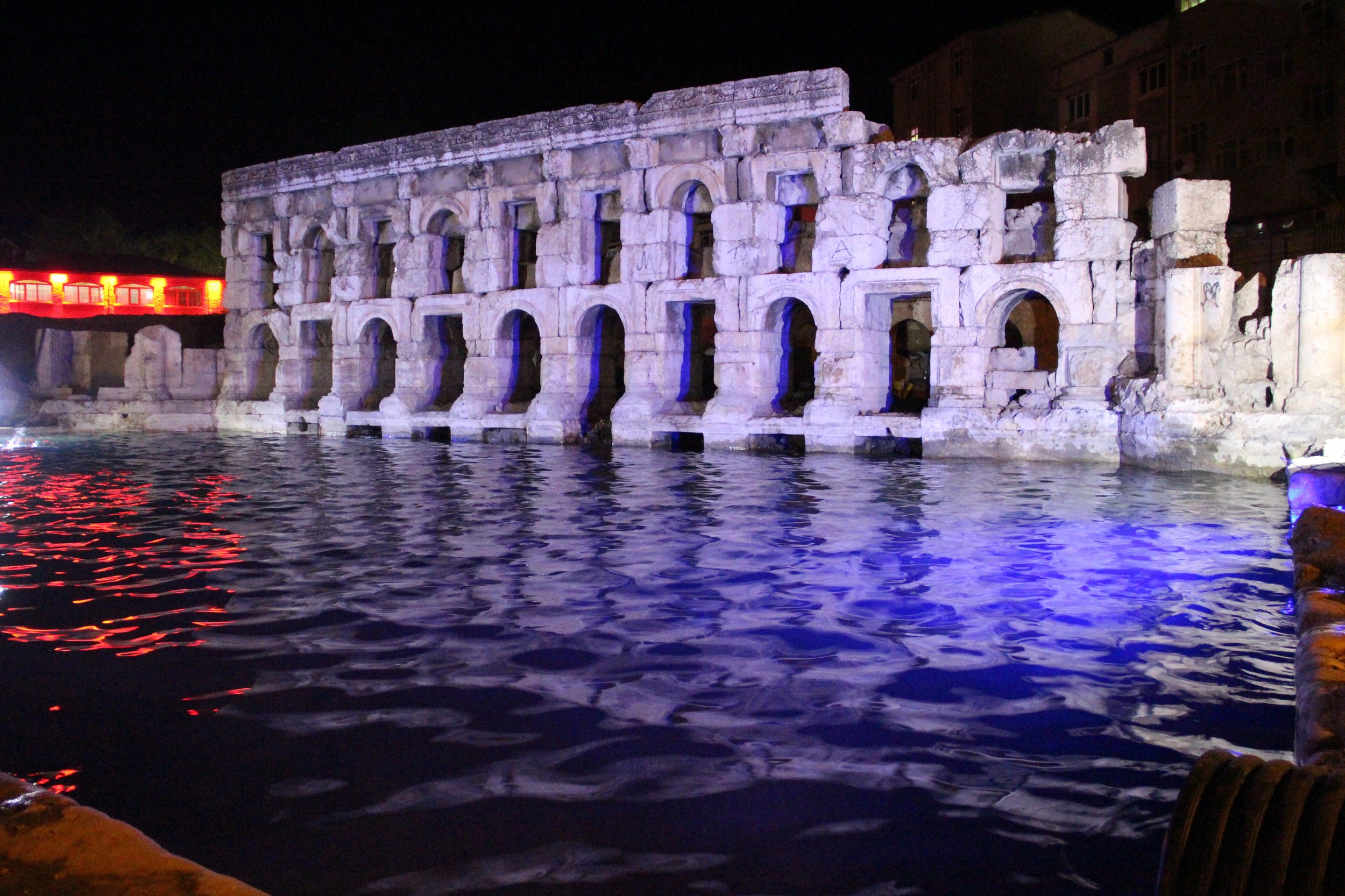
The poor girl, who is now living the few days of her life, wanders around this muddy pond to be consoled, and from time to time goes into the mud with her friends. Here, the mud and hot water she enters for walking and consolation is good for the girl. She stays here for a while, day by day the girl’s illness starts to get better. The blunt knees open; He begins to walk slowly. It turns out that the beautiful girl, who finally recovered completely, is better than the hot water here. Thereupon, the girl’s father, the king, had a marble pool built here, surrounded by large cut stones, and a city was formed around this pool, where there was no one before. The name of the king’s daughter is given to this new city.
The name of this city with a population of seventy thousand is “Öper” or “Hoperi”. Transportation to the city is provided from the Yozgat and Kayseri highways passing through the Beştepeler area of Sarıkaya. This great city was destroyed by an earthquake, only the baths remained.