
Here is a list of the top five most influential flying wings in aviation history. Flying wings are aircraft designed around a wing, rather than a traditional aircraft with a tail, fuselage and traditional wings. Flying wings may have originally been developed to the prototype stage by Nazi Germany with their Horten Ho 229 and Northrop with the N-9M, but this list looks at the top five flying wings thru aviation history in chronological order.
1 Horten Ho 229/Gotha Go 229
Nazi Germany’s attempt at flying wing production
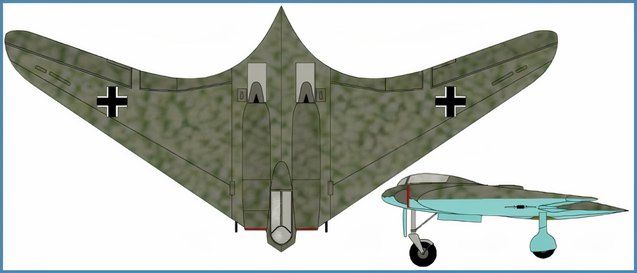
The first serious development of the flying wing design was with Nazi Germany and the small aviation firm Horten’s Ho 229. The Ho 229 would be intended as a jet fighter to shoot down the thousands of Allied bombers creating a second front by bombing Nazi Germany’s industry by day and night – as its origins would start in 1943 when Allied strategic bombing got serious and the Luftwaffe’s leader Hermann Göring wanted a real solution..
The idea did though come to Reimar and Walter Horten, a Luftwaffe veteran of the Battle of Britain designed the Ho 229 in response to the fact that Luftwaffe fighters in the Battle of Britain would have very limited fuel reserves and be very vulnerable. According to the Smithsonian Air & Space Museum, Reimar Horten as a designer and aerodynamicist would work independently of the Nazi regime of the 1930s and 1940s to develop his flying wing design.
Meanwhile, Walter heard Göring complain in early 1943 about all the different types of two-engine aircraft in the Luftwaffe that were ineffective and lacking interchangeable parts. So Göring laid down specifications for what he would consider acceptable two-engine aircraft, and Reimar informed Göring only a jet engined aircraft would do. By August 1943, Remiar was told he had six months to make a flying prototype. In September 1944, Gotha got chosen to build the flying wing jets to hopefully penetrate 1,000 kilometers with 1,000 kilograms of bombs.
Graphic: Nuricom | Wikimedia Commons
But instead of being a wooden wonder jet bomber, the Ho 229 would pan out at three prototypes. Some of the reasons would be engine development problems, and delays in development to where only an unpowered glider model would fly in March 1944. It took until mid-December 1944 for a powered version of the Ho 229 to finally fly – but by its third test flight, the test aircraft experienced an engine failure and killed its test pilot Erwin Ziller. Like the Me-262, the Ho 229 used the six-stage axial-flow BMW P 3302.
Nonetheless, with Nazi Germany being rolled back by the Allies, development continued and a bomber variant was started to be able to bomb the United States. There was even according to the Smithsonian Air & Space Museum, a primitive effort to cover the third Ho 229 prototype with a radar absorbing charcoal.
But the US Army would find the third Ho 229 prototype instead and eventually efforts would be made to restore it by the Smithsonian Air & Space Museum. Additionally, there would be tests to see how stealthy the design was as one can see below.
Although the Ho 229 did not make it into production, the Ho 229 efforts helped answer basic questions about how to make a flying wing work.
2 Northrop XB-35/YB-49
Northrop’s first attempts at a flying wing strategic bomber
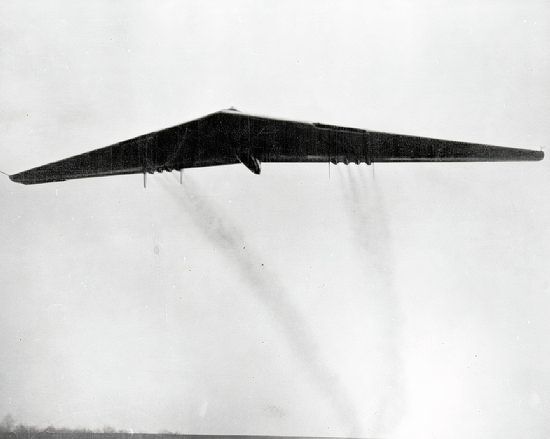
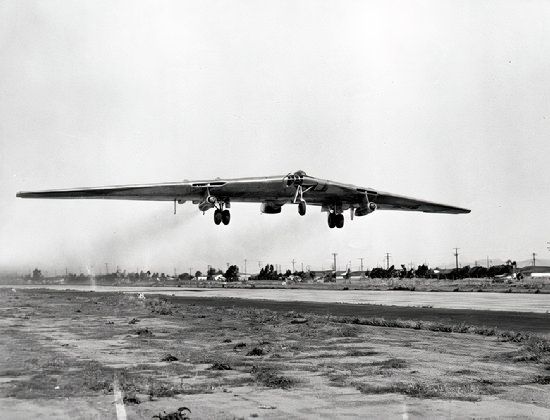
The Northrop XB-35, which would become the YB-49, was the world’s first bomber-size flying wing. Eventually 14 of these extraordinary aircraft would be built at the urging of Northrop’s leader Jack Northrop to have a flying design that was focused on providing lift. As a result, the YB-35 would be able to carry more payload further and faster than the conventional designs at the time.
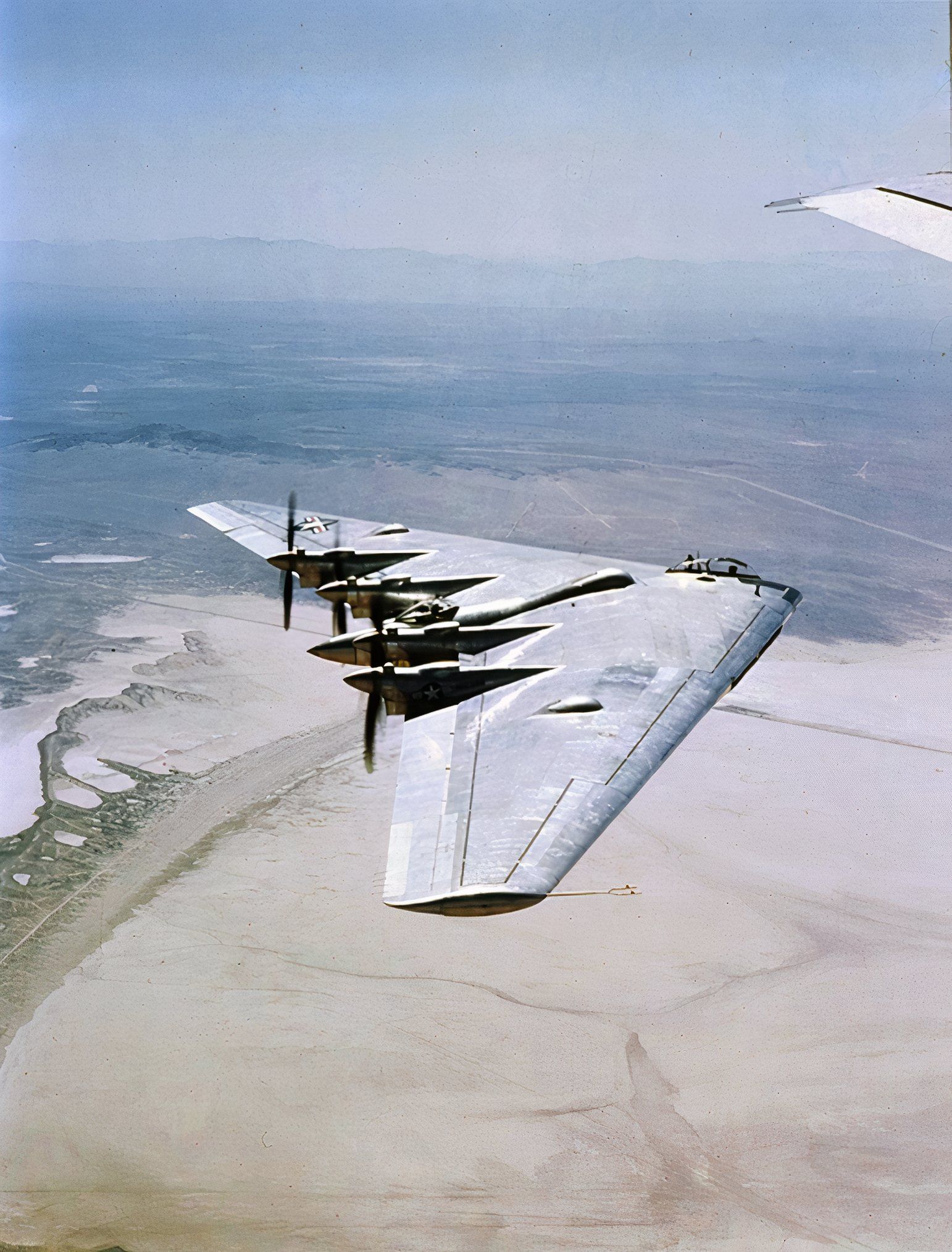
Photo: National Museum of the United States Air Force | Wikimedia Commons
Considering that in 1941 there was a fear Great Britain could fall to Nazi Germany, the United States of America wanted a truly long range strategic bomber. So the US Army Air Corps issued a contract to Northrop for two full size prototypes and yes, two 1/3rd scale models in the N-9M to test the design.
The XB-35 would come with contra-rotating propellers and have serious development complications – mostly around powerplant development. However, the era of propeller-powered combat aircraft was coming to an end, so the US Army Air Corps and Northrop decided to try a jet-powered version in the YB-49.
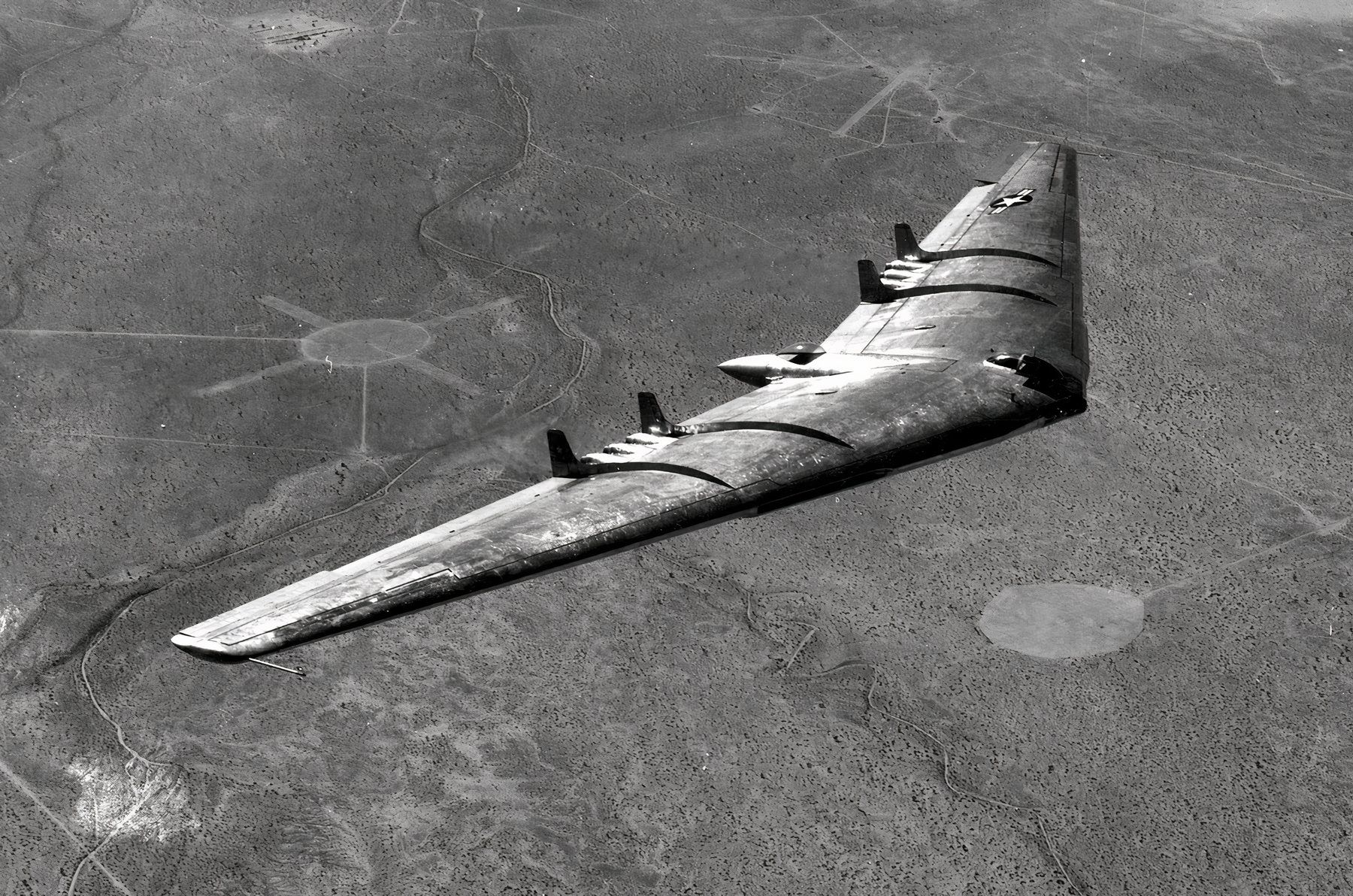
Photo: US Air Force Photo | Flickr
An early YB-49 crash that claimed the lives of among others, Captain Glen Edwards, would lead to naming the California test base Edwards Air Force Base. But the YB-49 would despites its troubles, some of which suspected by favoritism towards Northrop’s competitor Convair – and some trying to shove Northrop into merging with Convair, push flying wing design forward.
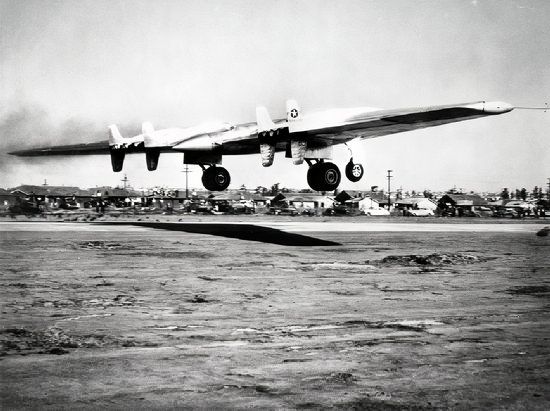
One of the discoveries made was that a flying wing had a lower radar return than a conventional design – and this would lead decades later to Northrop’s B-2 & B-21 successes. Below are some slides from the San Diego Air and Space Museum archive:
But the fact that early jet engines were more thirsty did not help the YB-49’s cause, with a significant range reduction compared to the XB-35. Additionally, Boeing was rolling out the B-47 Stratojet that had a more conventional all-jet design intended for the higher altitude and speed performance the new US Air Force won. So the YB-49 ended up scrapped.
3 Armstrong Whitworth A.W.52
United Kingdom’s attempt at a flying wing causes an ejection instead
The British also attempted to develop a flying wing, in this case the Armstrong Whitworh A.W.52. However, the Brits would find developing an ejection seat that worked was the more historically significant development with the A.W. 52, which had a first flight of November 13, 1947. This was several years after a glider prototype started flying on March 2, 1945.
The A.W. 52 had tall wingtips and was intended to be a prototype for a jet airliner the relative size of a Boeing 737. Additionally, the A.W. 52 packed two Rolls-Royce Nene engines and was based on a glider prototype.
As the A.W. 52 was put thru its paces, according to airscapemag.com, there was a massive flutter problem. The flutter would cap the A.W. 52’s speed at 300 miles per hour, not the 500 miles per hour sought by the designers. The lack of understanding about laminar flow impacted the wing design, which helped lead to this flutter. But testing continued.
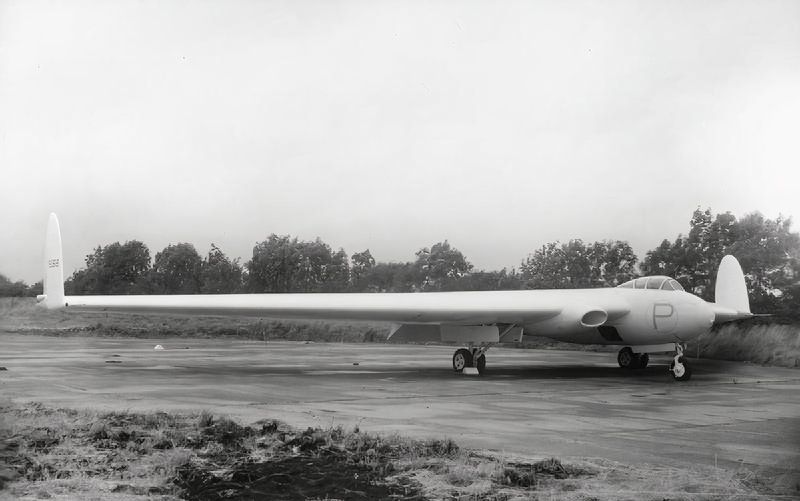
Photo: Imperial War Museums | Wikimedia Commons
Testing continued to such a point that the A.W. 52 made history a couple of years later on May 30, 1949. Quoting airscapemag.com,
“On May 30th, 1949, test pilot J.O. ‘Joe’ Lancaster experienced an asymmetric elevon flutter while diving TS 363 at 320 mph or 278 kts (515 kph). The flutter rapidly increased in frequency and, expecting imminent structural failure, Lancaster ejected. In doing so, he became the first British pilot to use an ejection seat (and a new A.W.52 technology that locked the controls forward and clear of his legs during the ejection) in an emergency.”
Lancaster’s ejection would lead to many more Martin-Baker ejection seat uses. Although Lancaster was not the first pilot to eject – that distinction goes to Nazi Germany test pilot Helmut Schenk who, on January 13, 1942, had to eject from his He 280 test plane due to a loss of control.
Another prototype was used to complete some additional A.W. 52 testing, but after the May 30, 1949 ejection hope was lost for the A.W. 52 being put into development. A few decades would go by before another serious effort to develop a flying wing.
4 Northrop B-2 Spirit
The world’s first production flying wing aircraft
Much has been written about Northrop’s B-2 Spirit stealth bomber, which was the first flying wing aircraft to enter production. A product of 1970s and 1980s engineering, the B-2 would benefit from computer-aided design and fly-by-wire technology that previous flying wing endeavors could not. Due to the high costs of the B-2, only 21 were built, and 19 fly today. The other two B-2s were lost in mishaps during training missions with no loss of life.
Additionally, the B-2 Spirit comes with radar-refracting paint to help reduce its radar signature. The B-2 Spirit was also the first aircraft to employ GPS-guided bombs in combat, dropping on specific coordinates.
Plus one ground test B-2 Spirit – the “Spirit of Ohio” – that never flew was placed in the US Air Force Museum and dedicated on December 16, 2003. As Col. Rick Matthews, B-2 system program office director,, shared at the event, according to a December 17 USAF statement,
“The first time I saw the B-2 is still etched permanently in my mind; it was so different. I wondered, as I’m sure many did, how this bat-winged vehicle could even fly, but it did. And it looked graceful. My guess is those who saw the Wright brothers and their new machine about 100 years ago felt the same way,”
The B-2’s success as a flying wing stealth bomber has not translated into commercial aviation as Armstrong Whitworth wished for their A.W.52; but the B-2 is currently about 10% of the bomber fleet. One can watch a documentary below on what it’s like to fly in the B-2
Finally, the B-2 can fly around the world with aerial refueling – the first flying wing with such a capability. The B-2 also inspired the intended replacement for the B-52 Stratofortress and B-1B Lancer.
5 Northrop B-21 Raider
Northrop’s latest flying wing bomber currently being tested
The US Air Force’s latest bomber is also a flying wing in the B-21 Raider. Like with other flying wings on this list, the B-21 is intended to pioneer new technology. In the case of the B-21, the B-21 will pioneer ample use of artificial intelligence – including flying uncrewed. Plus the B-21 Raider is designed from digital twins and simulations and with an open system architecture for seamless integration of new technologies.
Additionally, the B-21 test aircraft is not a prototype – to quote Northrop Grumman,
“Rather than a prototype, the B-21 test aircraft is equipped with mission systems and was built by the same manufacturing technicians using the same processes and tooling for production aircraft. The body of knowledge and experience gleaned in the development process supports a smooth transition into production on the path to delivering operational capability.”
For a bomber that is only 54 ft (16m) long and has a wingspan of 132 ft (40 m), with a payload of 180,000 lb (81,647 kg);.the B-21 is performing well in tests. Helps that the test B-21 comes with production communications and navigation systems. As such, the B-21 is continuing the flying wing design as a warfighting design.

Photo: Northrop Grumman
One can also see former US military pilots “Mover” and “Gronky” comment on the B-21 first flight below:
As the B-21 and B-2 make normal flying wing designs, the potential uses for a flying wing design grow and evolve as the flying wing design is inherently aerodynamically efficient. Aerodynamic efficiency leads to less fuel burn to go the same distance.