
World War II involved combatants from most of the world’s nations and was considered the deadliest war in history. Around 85 million military and civilians died as a result. The end finally came on Sept. 2, 1945, when Japanese officials signed the surrender documents aboard the battleship USS Missouri at Tokyo Bay, Japan.
Significant Events of World War II
Sept. 1, 1939:
Germany invades Poland, marking what many regard as the start of the war, though Japan invaded China on July 7, 1937. Two days later, France and the United Kingdom declare war on Germany.
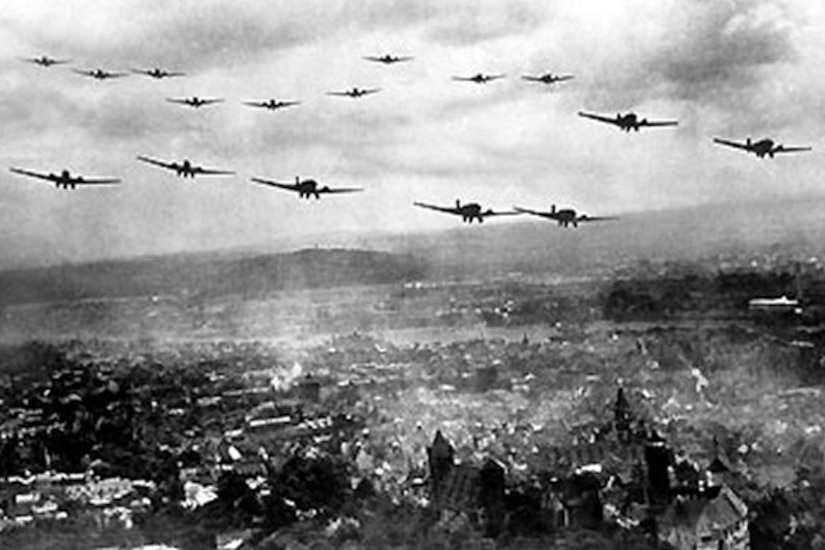
German planes fly over Poland, Sept. 1939.
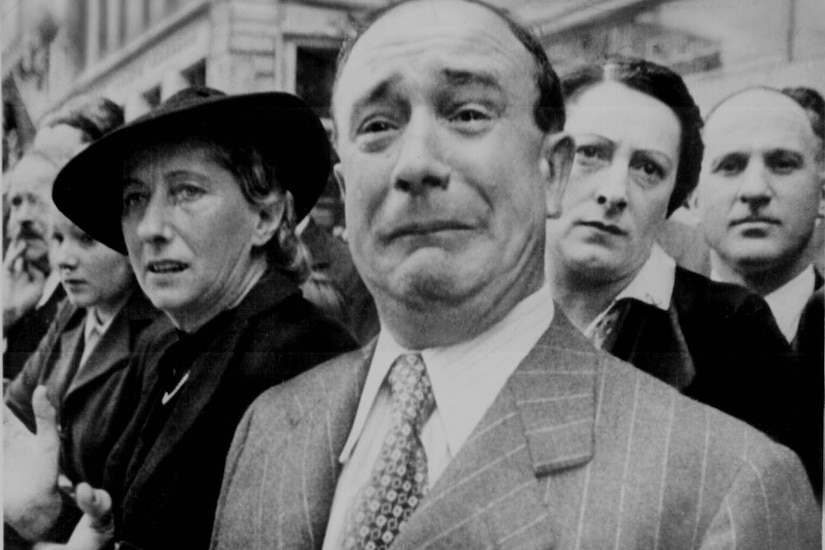
A Frenchman weeps as German soldiers march into Paris on June 14, 1940, after the Allied armies had been driven back across France.
April 9 to June 22, 1940:
Germany takes control of much of Western Europe, including France.
July 10, 1940:
Germany launches an air war, known as the Battle of Britain, against the United Kingdom.

Saint Paul’s Cathedral in London is seen as the city burns around it during the great fire raid, one of the most destructive Nazi bombings of London, Dec. 29, 1940.
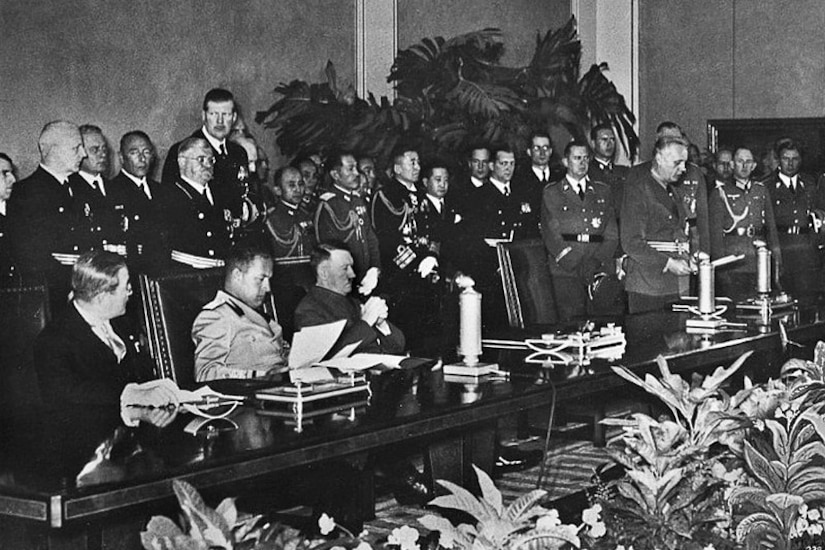
Leaders of the Axis powers, Japan, Italy and Germany, sign the Tripartite Pact, creating an alliance between the three countries, Sept. 1940.
Sept. 22, 1940:
Germany, Italy and Japan sign the Tripartite Pact.
Dec. 7, 1941:
Japan’s naval air force attacks military bases on Oahu, Hawaii.

The USS Arizona burns after the Japanese attack on Pearl Harbor, Dec. 7, 1941.
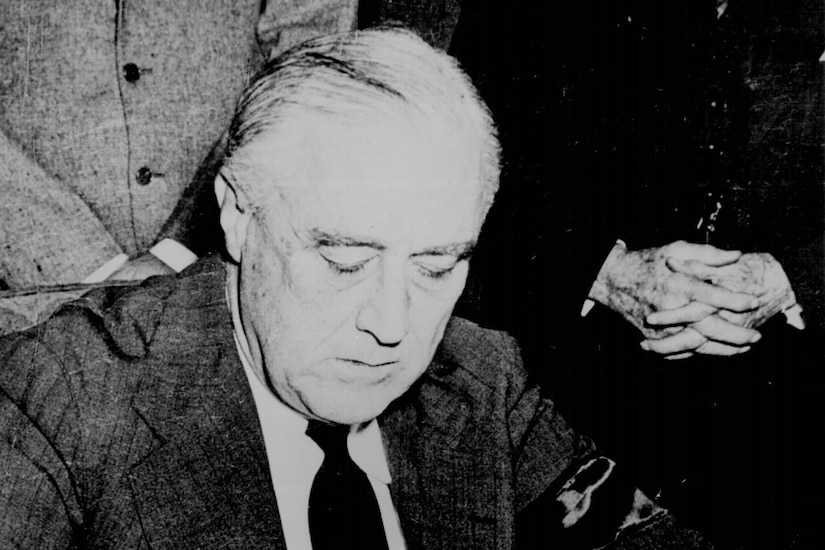
President Franklin D. Roosevelt signs the declaration of war against Japan, Dec. 8, 1941.
Dec. 8, 1941:
The United States declares war against Japan.
Dec. 11, 1941:
The United States declares war on Germany and Italy.
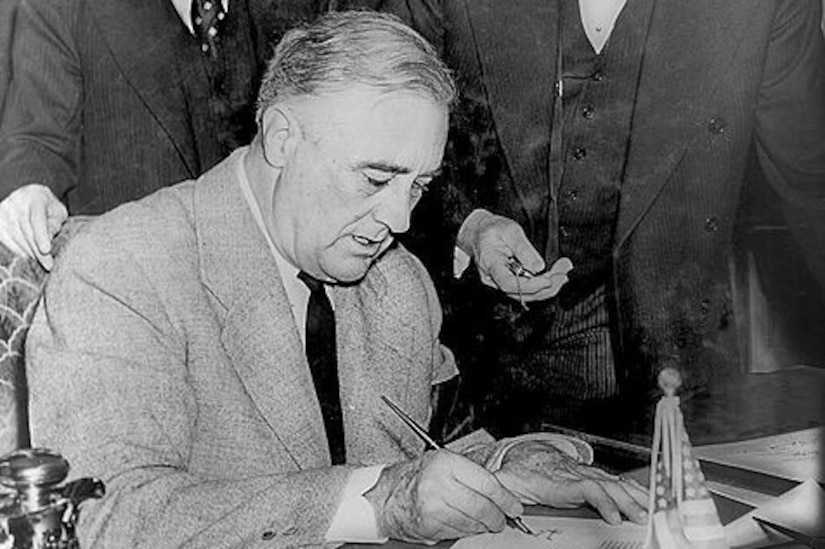
President Franklin D. Roosevelt signs the declaration of war against Germany, Dec. 11, 1941.
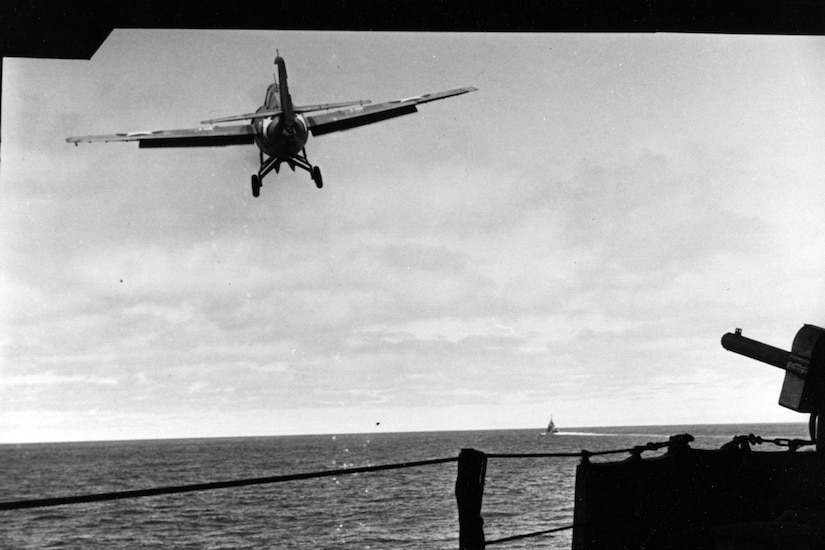
A Grumman F4F-4 Wildcat fighter takes off from the USS Yorktown on combat air patrol during the Battle of Midway, June 4, 1942.
June 4 to 7, 1942:
The U.S. Navy defeats the Japanese navy at the Battle of Midway.
July 9, 1942:
Allied forces invade Sicily.
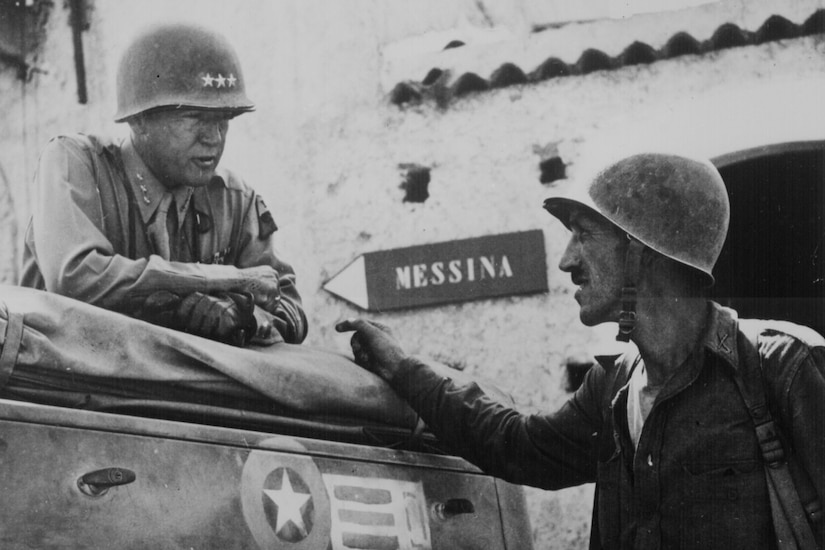
Army Gen. George S. Patton, left, speaks with Army Lt. Col. Lyle B. Bernard on the outskirts of Messina, Sicily, Aug. 17, 1943.
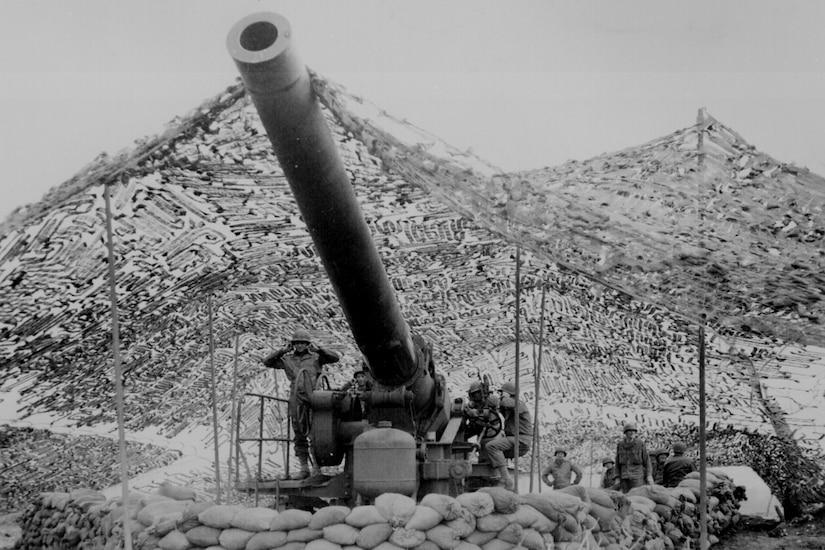
The front view of an American 240mm howitzer just before it fires into German held territory in Italy, Jan. 30, 1944.
Sept. 8, 1943:
Italy surrenders to the Allies, but German forces occupy northern Italy.
June 6, 1944:
Allied forces land on the beaches of Normandy, France, marking D-Day.

Soldiers wade ashore on Utah Beach in Normandy, France, on D-Day, June 6, 1944.

Members of Pennsylvania’s 28th Infantry Division drive and march down the Avenue des Champs-Élysées in Paris, Aug. 29, 1944.
Aug. 25, 1944:
Allies take control of Paris.
Dec. 16, 1944:
Germans counterattack in northern France, Belgium and Luxembourg, known as the Battle of the Bulge.
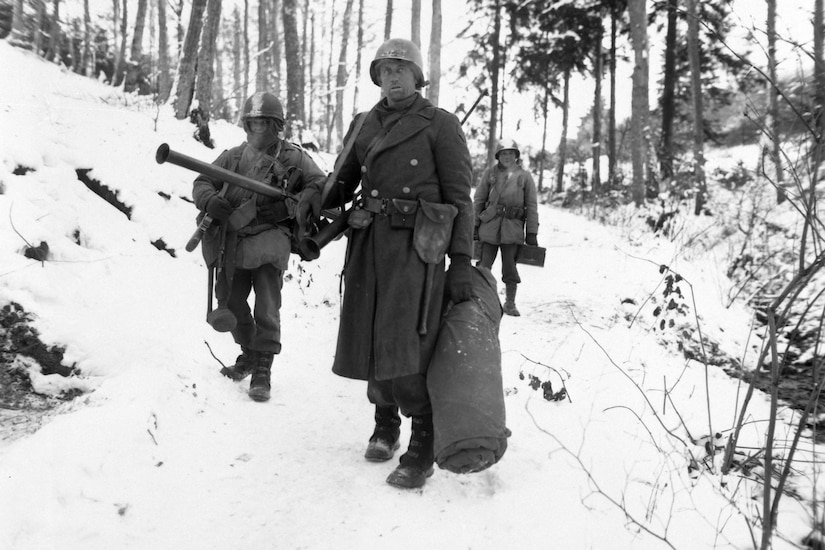
Army engineers emerge from defensive positions in the vicinity of Bastogne, Belgium, after fighting in the Battle of the Bulge.

Marines land on Iwo Jima, Feb. 19, 1945.
Feb. 19, 1945:
U.S. Marines land on the Japanese island of Iwo Jima.
March 22, 1945:
The U.S. 3rd Army crosses the Rhine River in Germany.
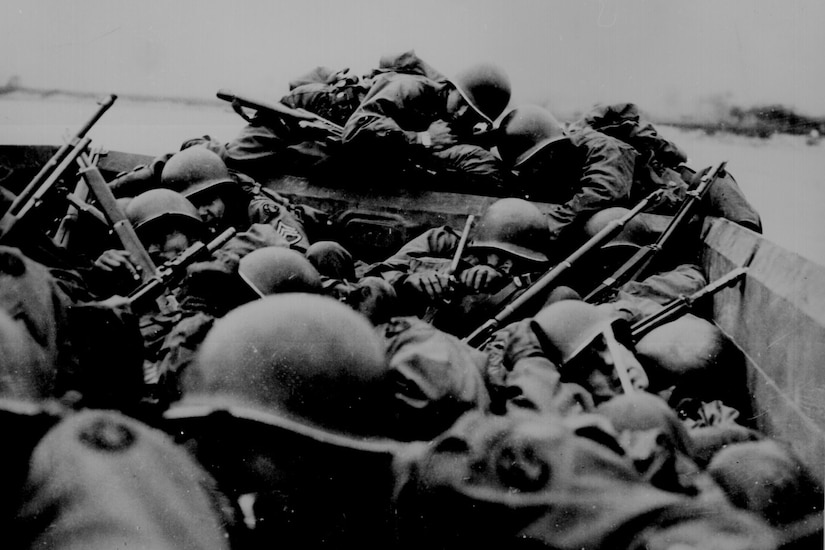
U.S. troops cross the Rhine River in Germany under enemy fire, March, 1945.
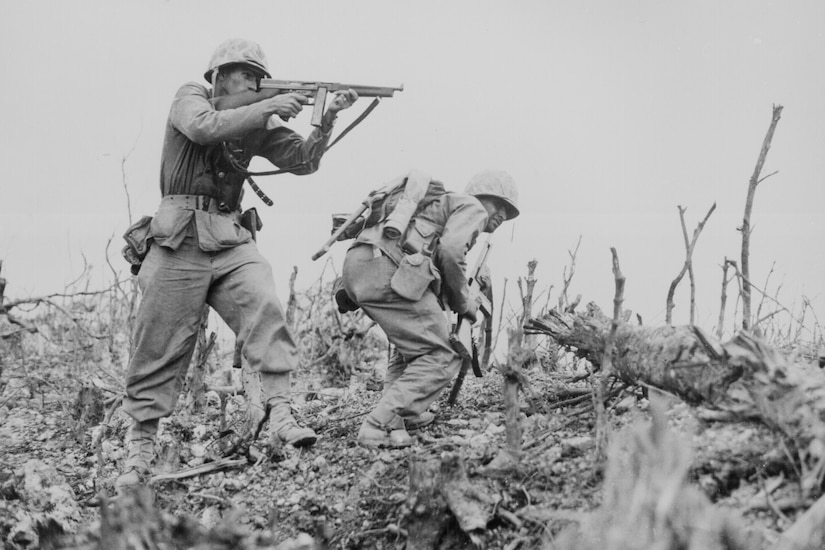
A Marine assigned to the 1st Marine Division aims his gun at a Japanese sniper during fighting on Okinawa, June 22, 1945.
April 1, 1945:
U.S. soldiers and Marines invade Okinawa, Japan.
April 25, 1945:
The Soviet army encircles Berlin and links up with the Americans on the Elbe River.

A U.S. and Russian soldier smile together after the historic meeting of their respective armies near Torgau, Germany, April 25, 1945.
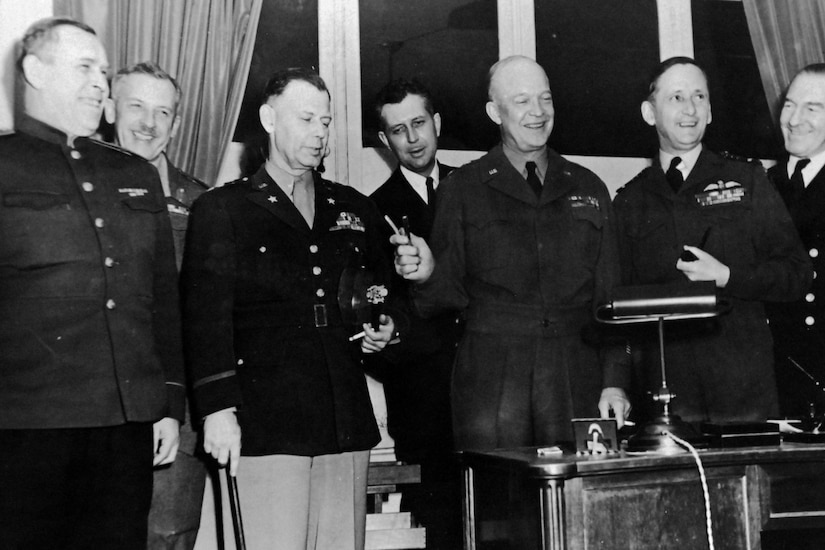
General Dwight D. Eisenhower, Supreme Allied Commander, third from left, stands with other top military officials holding the pen with which the unconditional surrender of Germany was signed in Reims, France, May 7, 1945.
May 8, 1945:
Germany surrenders to the Allies, marking V-E Day.
Aug. 6, 1945:
The U.S. drops an atomic bomb on Hiroshima, Japan.
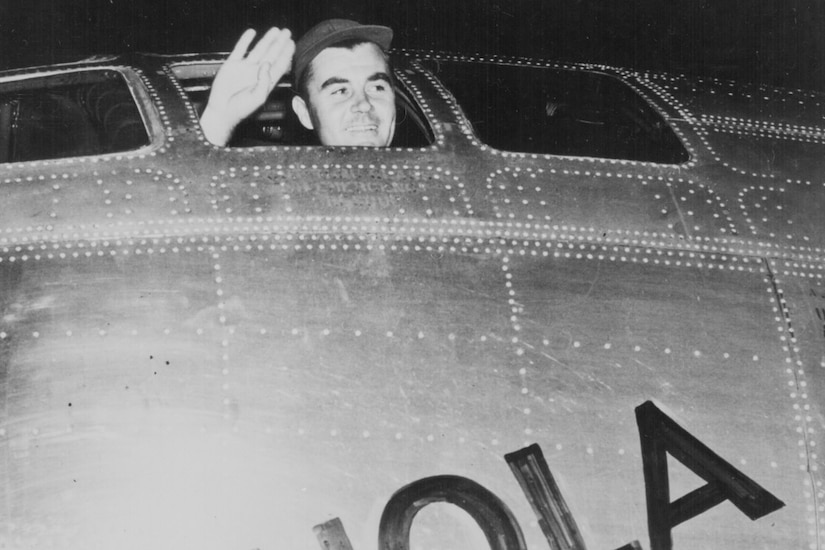
Air Force Col. Paul W. Tibbets, Jr., the pilot of the Enola Gay, waves from his cockpit before takeoff on the flight that would drop the atomic bomb on Hiroshima, Japan, Aug. 6. 1945.
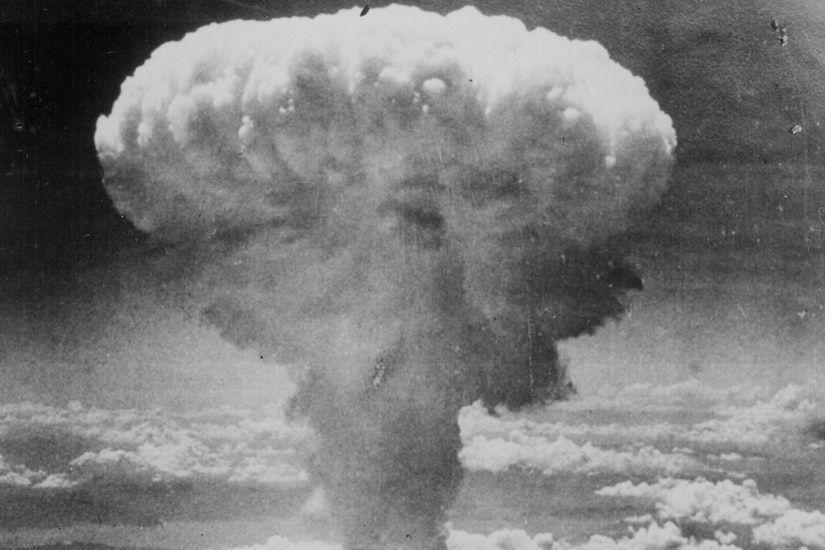
A dense column of smoke rises thousands of feet in the air after the U.S. dropped an atomic bomb on Nagasaki, Japan, Aug. 9, 1945.
Aug. 9, 1945:
The U.S. drops an atomic bomb on Nagasaki, Japan.
Sept. 2, 1945:
Japan formally surrenders to the Allies, marking V-J Day, although the initial announcement of surrender was made Aug. 15, 1945.
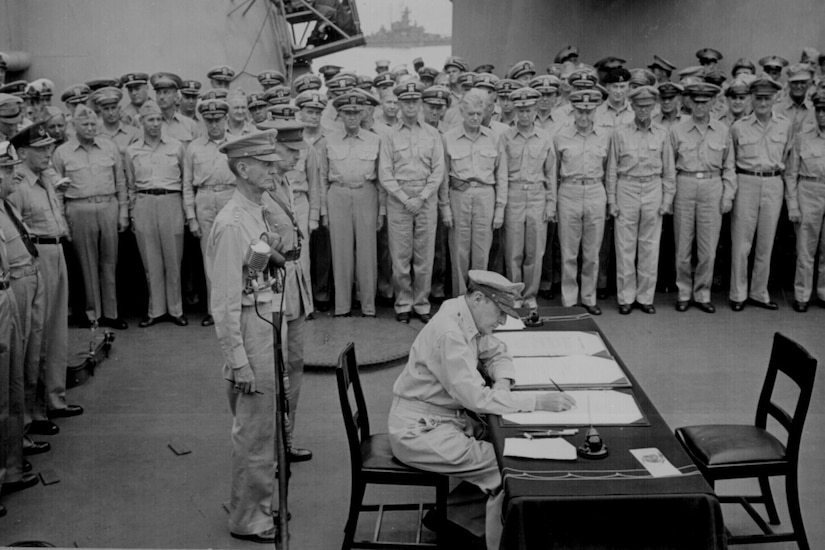
Supreme Allied Commander Army General Douglas MacArthur signs the formal Japanese surrender during ceremonies on the USS Missouri in Tokyo Bay, Japan, Sept. 2, 1945.