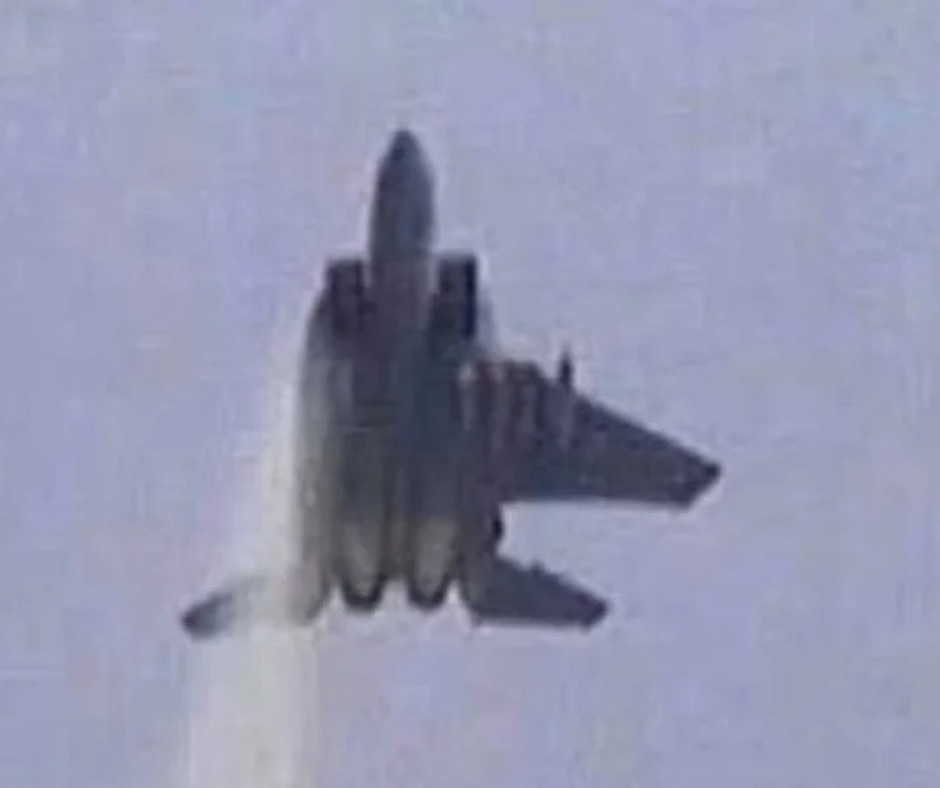

The F-15 Eagle is one of the superstars of aviation, and its incredible 104-to-0 air-to-air kill ratio makes it also one of the most successful fighters of all time. The undefeated champion of the skies proved that it was more than worth its salt on numerous occasions. One of the first air forces to put it into combat was the Israeli military, shortly after the plane’s operational debut in 1979. The IAF (Israeli Air Force) is also the single military in the world to have almost downed an F-15.
The F-15 was born of spite and sheer Cold War hatred, but also out of a massive intelligence flop on the United States’ part. It all came down to a misinformation facepalm of cosmic proportions. Back in 1967, the Soviets announced the Mikoyan-Gurevich MiG-25, and the Americans were convinced it was the ultimate fighter of its day. Enough to put more than a few people on the waiting list of sleep disorder therapists.
Eventually, in 1976, a soviet pilot defected to Japan, taking a MiG-25 to serve as his ride, together with the technical manual for the damn thing. The US intelligence and military thought Christmas had come early (the incident happened on September 6), and the MiG-25’s aura of invincibility began to fade to black. One feared as the nemesis of the SR-71 Blackbird spy plane, the MiG-25 Foxbat proved to be all Soviet propaganda hype.
However, by that time, the US had prepared countermeasures that effectively took the shape of the F-15 air superiority fighter. Tired of being constantly one-upped by the Soviets (at least on paper), the aviation brass hats at the Pentagon and elsewhere went all in, and then some. The F-15 was a no-nonsense warbird designed to hunt in all kinds of weather, climate, or frontline, kill the other guys, and come back home safely.

In 1979, shortly after the Israeli Air Force took the keys to the first batch of F-15s, they scored the first air kill on the fighter’s tab. That track record would eventually expand to over sixty confirmed shootdowns. The US Air Force, on the other hand, took it to war over a decade later, in 1991, during the Desert Storming of Iraq, in the first Gulf War. 34 enemies later, the F-15 declared it had nothing else to prove, and called it a day. By the way, the air kills recorded by the allied troops against Saddam Hussein’s warplanes had a final tally of 37. That should say something about the F-15’s capabilities.
So far, no enemy pilot has managed to shoot down an F-15. “Enemy” is the keyword here – the F-15’s dogfighting skills proved it is just as much about the size of the dog in the fight as it is about the fight in the dog. But even the invincible aircraft’s magnificent radars and high-tech equipment couldn’t get it out of a very close call mid-air collision in 1983. However brutal, the incident instantly propelled the F-15 into legendhood (for good reason).
Let’s rewind to May 1, 1983, Negev Desert, Israel. Two F-15Ds (the two-seater variant) played a game of war against four A-4N Skyhawks. Basically, cops and robbers, but with real war machines (albeit without live ammunition). It was an “airfield defense” exercise, where the new jets had to get rid of the “aggressors” (in this case, the A-4s).

Photo: wikipedia.orgAt the time, Israel was engaged in a war against Lebanon, and one of the F-15s in this scenario (the IAF pilots knew it by its call sign “Baz” – Falcon, tail number 957) already had four scalps on its sash. It was this exact aircraft that would become the most famous F-15 in the world, and it all started with a spirited dogfight between the two squadrons. Not a real one, of course, but except for missiles and Vulcan cannon shells, everything was very much authentic: speed, chase, close-call fly-bys, the lot.
Including the inverted maneuver performed by one of the A-4s, which had the other F-15 squarely in its sights. What it didn’t have eyes on was the Baz, which was right on top of it. Not a metaphor: Captain Zivi Nedivi, the pilot of the Baz, was flying directly above the A-4, ready to score a virtual kill. The Skyhawk was trying to get a lock on the other F-15, and in doing so, it pulled up. Straight through Nedivi’s right wing.
Behind the pilot was Yehoar Gal, an instructor who took the back seat to train his fellow aviator (Nedivi was still getting the hang of the F-15 during the exercise). And here’s where things took a turn for history: normally, after a mid-air collision that sends your Mach 2.5 fighter jet into an uncontrolled spin toward the ground, a pilot’s reaction is to exit, safely attached to his parachute, and leave the plane to care for itself.

Photo: wikipedia.orgNedivi was still in training, remember? Maybe emergency crash protocols hadn’t been fully studied yet, because he decided to do the one thing the military didn’t design the planes to do: go full afterburner in a crash-course with Mother Earth. Yup, the Israeli Captain punched the throttle’s dual levers all the way forward. With the twin turbofans burning fuel in double shifts, the F-15 revealed why the military sometimes pulls all stops and creates a masterpiece.
Due to its particular construction, with a wide body and a high wing-to-fuselage ratio, the airplane gained enough lift to stabilize. With one wing missing, sheared clean off, some two feet from the shoulder, and bleeding fuel all over the Middle East at that point. It was basically a fountain in the sky, spewing kerosene like it tried to win the gold at the crop dusters’ Olympics.
It was at that precise moment in time that the F-15’s creators realized the airplane’s one major oversight: they had failed to put a middle finger among the optional extras, so that the fighter could promptly salute physics, gravity, and common sense in general by simply not falling out of the sky, even with its right wing flapping freely somewhere else.

Photo: Facebook/IAFACTSHaving regained control over his plane, the pilot overrode his instructor (who, incidentally, was lower in military rank than Captain Nedivi), and told him to remain seated AND in the cockpit. They would not eject. They tried their best to assess their situation, but the geyser on the right made it absolutely impossible to see how badly they were hit.
At this point, let’s take a short commercial break from the Baz’s crew adventures/crisis, and turn our attention to the A-4 Skyhawk that inadvertently fathered this magnificent F-uppery (F is for fighter, by the way). After ending its role as a guillotine, the obsolete plane declared forfeit, exploded, spat its pilot out automatically, and then pursued a career in applied physics by promptly scattering itself across a considerable portion of the Negev desert.
Break over. Back to the protagonist. With the antagonist down, the F-15, having completed its wargame mission of neutralizing the Skyhawk foe (in an overenthusiastic manner that can be considered the most cowboy “Job Done” affair in a peaceful exercise), turned its attention toward the nearest airfield. Ramon airbase was just ten nautical miles away.

Photo: theaviationgeekclub.comNormally, that’s a one-minute hop for an F-15 going at cruising speed (nearly 500 knots, or 575 mph, or 930 kph). How long it actually took must have seemed like ages for the two IAF aviators, but the show wasn’t over just yet. In fact, the best part was about to come – what else but a grand finale for a grandiose haymaker of a “Mission successfully failed” type of job?
Keeping the plane stable mid-air with raw speed and brute force from the twin jet engines was a good exercise in testicular metallurgy show-off from the two Israeli pilots, but getting down on the ground willingly (and preferably alive and well) was their ultimate goal at the moment. It was later determined, after rigorous wind tunnel tests, that the one-winged F-15 had to stay within 20 knots of a certain airspeed and within 20 degrees of a precise angle in order to pull off that incredible feat it was about to do.
Having alerted the tower about the emergency nature of their landing request, the Baz fliers went for the final approach. A slowing-down attempt was unceremoniously scrapped by Zivi Nedivi when the plane bucked violently, so he gunned it again. At roughly twice the normal landing speed, the crippled warbird made contact. The pilot extended the arrestor hook at the back, which should have secured the cable laid on the runway.

Photo: theaviationgeekclub.comProblem number one: said hook was rated for normal landings, at 130 knots. At 250+, it snapped off the fuselage like a twig, triggering problem number two. While the F-15 had just proved it was basically a testosterone-fed rocket with a windshield and an attitude, stopping from excessive speed was not something its constructors had budgeted for.
So, it did the only reasonable (and sensible) thing to do: made a Hollywood-style entry, coasting to a stop some twenty feet away from the end-of-runway barriers. That’s about the length of a ’69 Pontiac Bonneville, with just enough room for the driver to sit on the hood, feet dangling over the bumper, enjoying the overdose of badassery displayed by the two Israeli men.
It was at that point, once the wounded plane halted, and the pilot opened the canopy, that he got the full scale of the disaster he had just blissfully ignored all along. “It’s highly likely that, if I had seen it, I would’ve ejected, ‘cause it was obvious you couldn’t really fly an airplane like that.” These are the exact words of Zivi Nedivi, recalling the incident. Apparently, no one had told him it was something his plane was not built to do – fly straight without a wing, and land safely. Blind courage is no metaphor in this case.

Photo: theaviationgeekclub.comNeedless to say, the two heroes, Nedivi and Gal, did the exact same thing any one of us would’ve done, given the circumstances: take photos. With selfies, yet to become a thing some three decades into the future, they posed for the camera, as if they had just completed a perfectly ordinary mission, with nothing to write home about.
The story is no, in fact, over: the plane was sent to be repaired, and came back into active service. Not only that, but it also shot down another enemy, a Syrian MiG, after it was recommissioned. McDonnell-Douglas experts came in to analyze the damage, and promptly declared that kind of damage could not have been sustained in flight.
Promptly proven dead wrong by facts, they went back to the drawing board, redid the math, and found out that the lift generated by the speeding F-15 basically made it act up, in the same manner a bullet doesn’t need wings to fly straight. Their secret conclusion was that there’s never such a thing as too much thrust, especially not on a fighter plane.