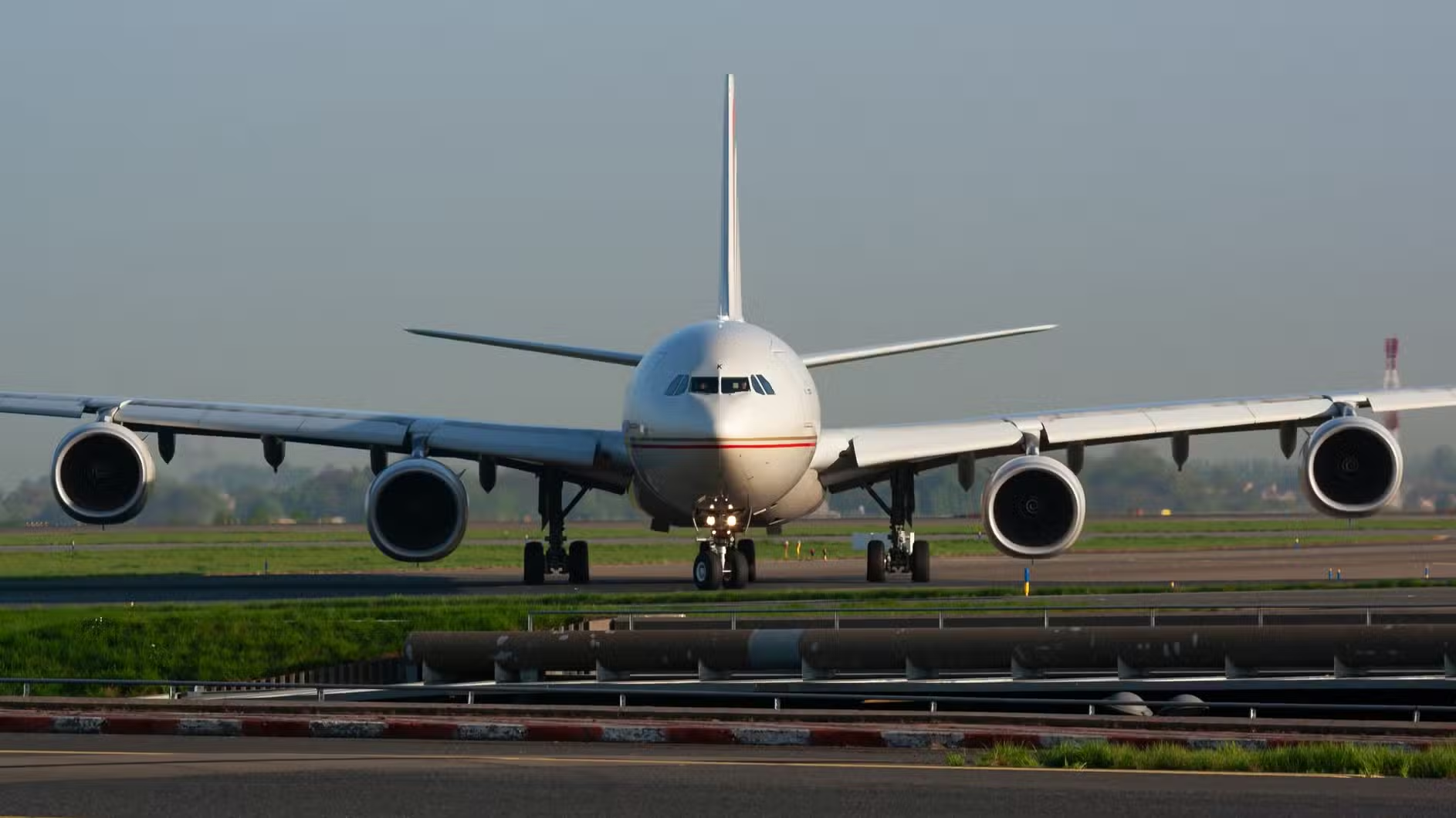
On November 15, 2007, a brand-new Airbus A340-600, due to be delivered to Etihad, was written off after an incident at Toulouse-Blagnac Airport (TLS). The quadjet was set to join the Abu Dhabi-based carrier’s fleet within the next few days, but the acquisition was eventually canceled. It is extremely rare for a brand-new aircraft worth about $275.4 million ($316.8 million today) to be written off as beyond economical repair, so let us look at how this happened.
A crash during engine tests
Before an aircraft makes its way from the manufacturer to the customer, it has to pass a series of tests. On the day of the incident, the A340, with test registration F-WWCJ, was in a test pen at Airbus’s headquarters in France to undergo stationary engine testing.
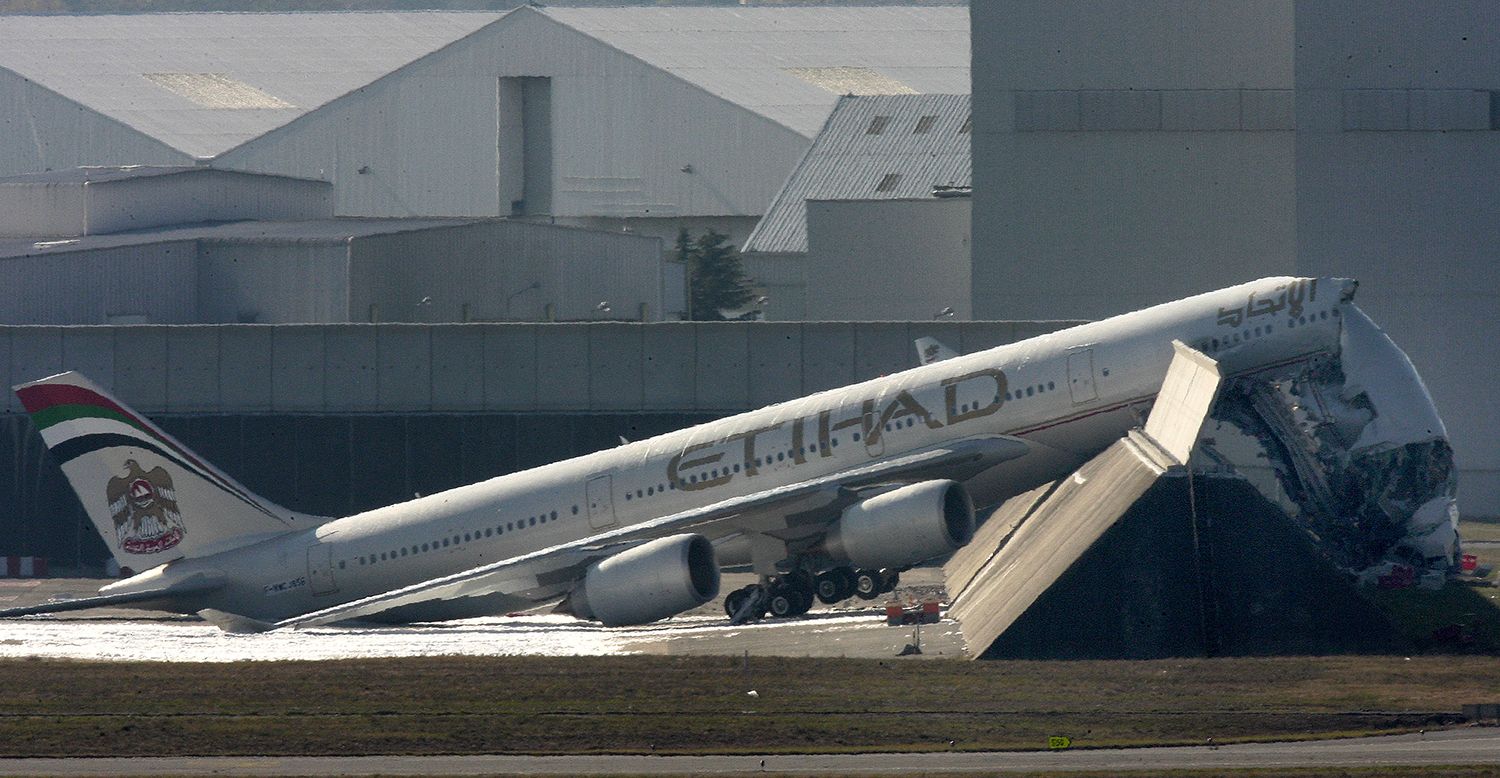
Photo: Bureau of Aircraft Accidents Archives
According to Aviation Safety Network, a team of engineers began these trials at 15:19 local time. Reports suggest that their purpose was to monitor the possibility of oil leaks. However, the engineers had not properly secured the aircraft with chocks.
To begin with, this didn’t result in anything untoward, with the Engine Pressure Ratio (EPR) being between 1.04 and 1.22 until 15:58. Following an hour’s break, testing recommenced with the engines running at higher thrust levels, with the EPR being as high as between 1.24 and 1.26 for three minutes. Eventually, this caused the unchocked aircraft to move.

Photo: Bureau of Aircraft Accidents Archives
The aircraft was in motion for 13 seconds before being brought abruptly to a stop. While engineers applied the brake pedals within seconds of the movement beginning, they did not reduce the thrust. This meant that, despite turning the plane to the right, it collided with the pen wall at around 30 knots (55 km/h).
As the aircraft was not restricted with chocks, one might wonder why it didn’t begin to move sooner. This was because its parking brake was applied and, therefore, only failed when the thrust was increased beyond its capabilities. Then, when the engineers applied the brake pedals as the plane started to move, the parking brake deactivated entirely, causing the plane to accelerate.
Damage to the plane and its occupants
As the aircraft turned 37 degrees to the right, it took just seven seconds to accelerate from 4 to 31 knots. This surge meant that when the aircraft came to impact the pen’s retaining wall, the impact on it and its occupants was significant. It came to a stop leaning on the wall, with its tail cone and the end of its right wing touching the ground.

Photo: Bureau of Aircraft Accidents Archives
The quadjet struck the concrete barrier at an angle of approximately 30 degrees. As seen in the images, the underside of the forward cabin was torn about 49.2 ft (15 meters) and bent downwards as it went through the wall. The cockpit crashed into the ground on the other side of the wall. Furthermore, engines one and two on the left side of the aircraft came into contact with the wall and were substantially damaged.
The collision also had safety and health implications for the aircraft’s occupants. Out of the nine people onboard F-WWCJ, five were injured, with four of them being serious. There were three people in the cockpit on the day. An Airbus employee was seated in the right seat and was responsible for the test. In the left seat was an employee of GAMCO, the company responsible for maintaining and receiving Etihad aircraft at the time. Another Airbus employee occupied the service seat.
The fact that the impact of the collision sheared the plane’s cockpit from its fuselage meant that writing the aircraft off was the only viable option. ATDB.aero notes that the wreckage was dismantled in 2008, with the tail briefly displayed at the Champs Elysées in Paris. Meanwhile, Virgin Atlantic reportedly used part of it as a cabin crew trainer.
The investigation and aftermath
The incident was subsequently the subject of an investigation by France’s Bureau of Enquiry and Analysis (BEA). The BEA’s inquiry found that the collision was the culmination of test procedure violations. It added that a lack of detection and correction of these violations had resulted in F-WWCJ’s terminal crash.
But why did those onboard the aircraft not think to reduce its thrust in tandem with their brake applications? This is where the human factor comes into play, with the BEA ultimately determining that,
“Surprise led the ground-test technician to focus on the braking system, so he did not think about reducing the engines’ thrust.”
Part of Etihad’s historical aircraft order
In July 2004, Etihad Airways signed a Memorandum of Understanding with Airbus to purchase 24 new planes, with up to 12 more options. The deal, worth over $7 billion, included the purchase of four Airbus A380s, four A340-500s, four A340-600s, and 12 A330-200s. At the time, the airline was only one year old, with a fleet of six aircraft.
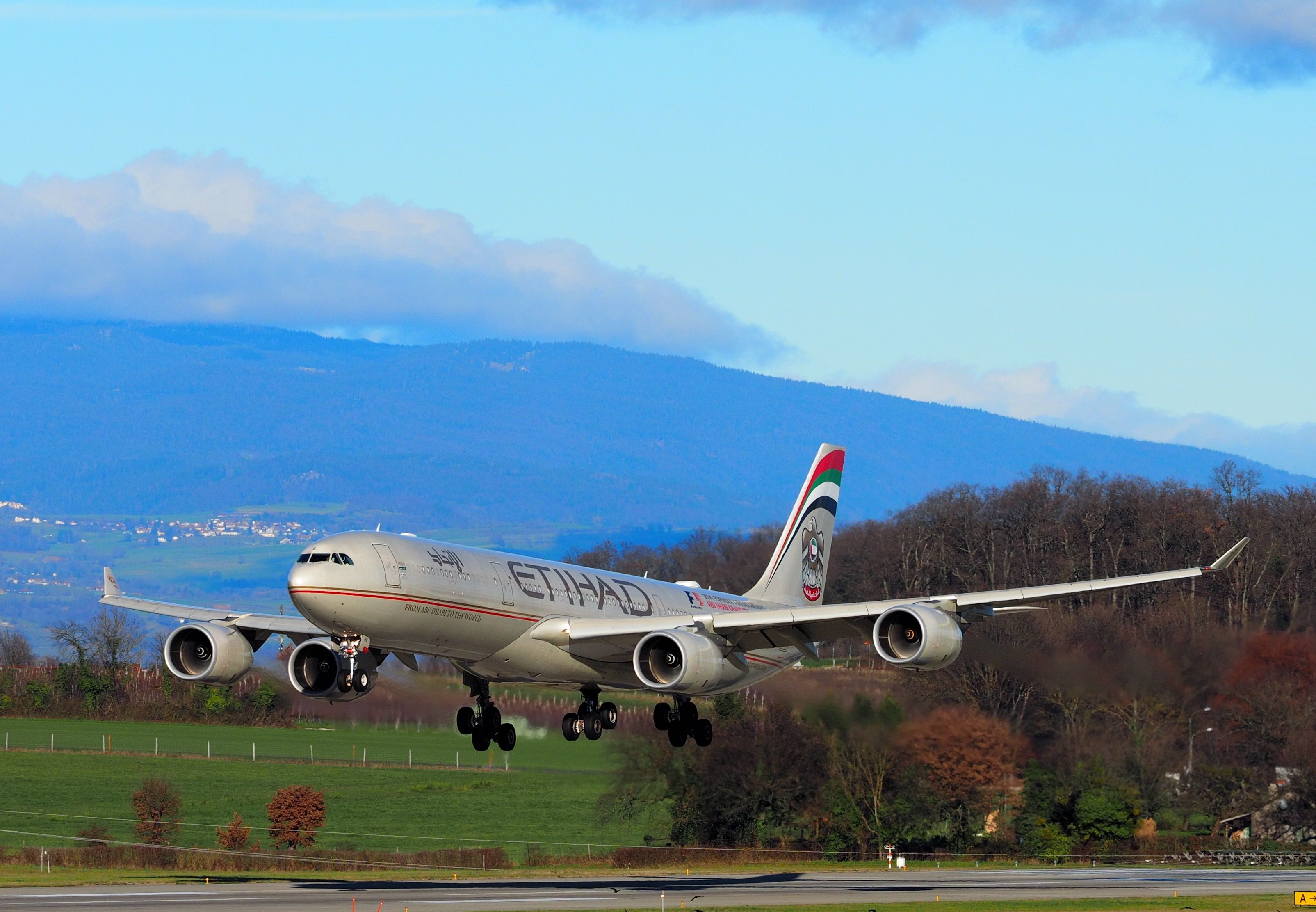
Deliveries for the A340-500s and A330-200s began in 2006, while deliveries for the A340-600s began in 2007. However, Etihad switched the -500s for more of the -600s, taking its entire orderbook with Airbus for the type to eight planes. Unfortunately, it ended up receiving seven of them. According to ATDB.aero, the first A340-600, registration A6-EHE, was delivered on June 29, 2007, followed by A6-EHF on August 28.

Photo: Vytautas Kielaitis | Shutterstock
F-WWCJ would be the third A340-600 to join Etihad’s fleet. It would take up the registration A6-EHG. The aircraft had been in testing for nearly two months before the incident. Its first flight took place on September 21, 2007. Its delivery to Etihad would have been exactly two months later, on November 21. At the time of the incident, it had accumulated 24 flight hours.
The A340-600 was not just the longest in the family but, at the time of its launch, also the longest in the world. It measured 75.36 meters (247 feet) from nose to tail. Etihad was keen to use this huge size to its advantage, leveraging its hub and spoke model to feed passengers between east and west through its hub at Abu Dhabi International Airport (AUH).