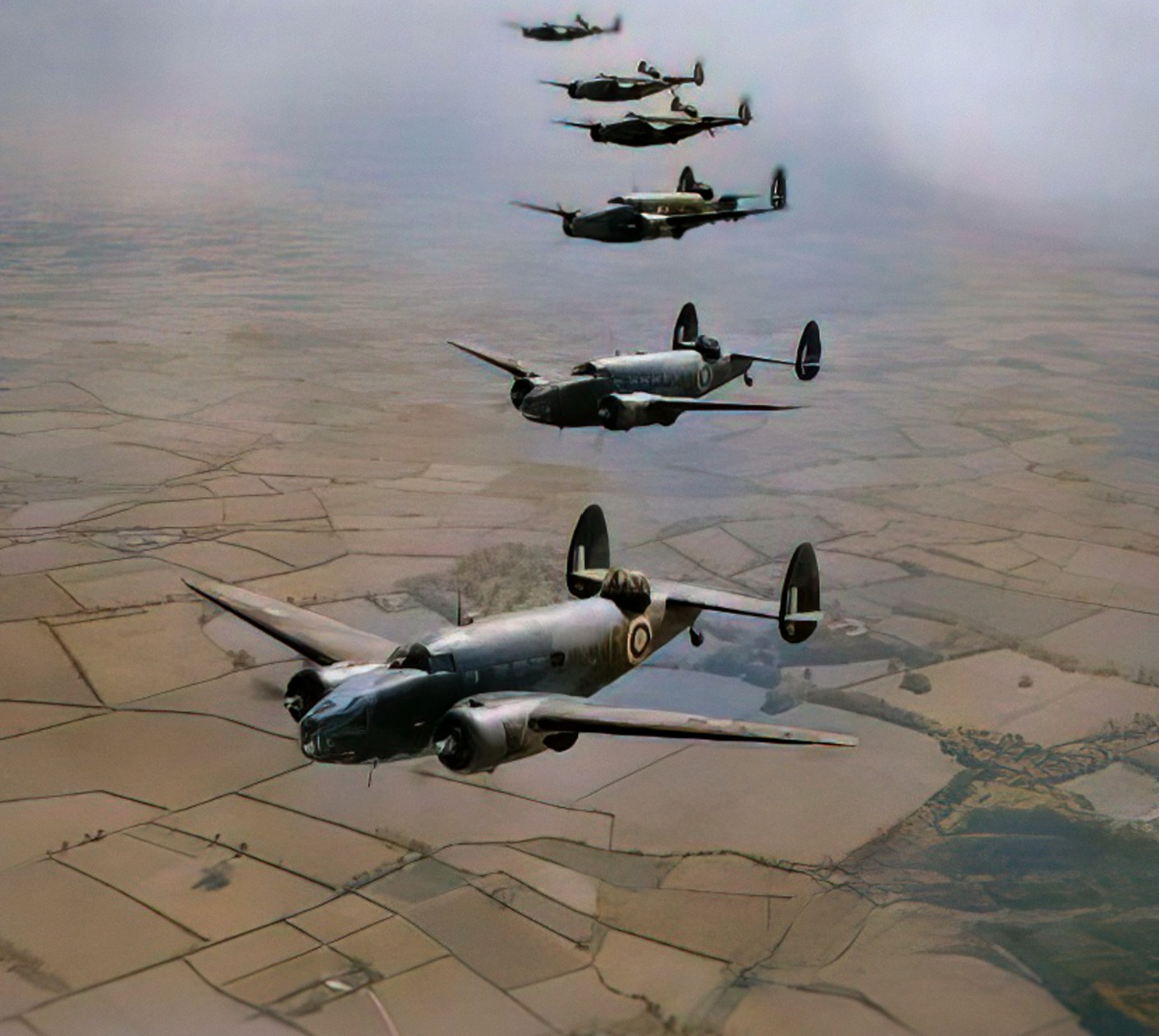

The Lockheed Hudson’s fighting career extended to all theatres of war – but history seems to have barely acknowledged this pugnacious campaigner. Andrew Thomas rights this wrong with an overview of the machine’s wartime service
Lockheed’s Hudson was the first American-built aircraft to see operational service with the RAF during World War Two. That alone would be enough to give it a niche in history, but as it served with such distinction in a variety of roles in every theatre, the type secured its name for posterity.
It was one of those robust machines that served throughout the war, mainly with the RAF’s Coastal Command but also in a variety of other roles, including as transport and trainers. While not remembered as fondly as the Westland Lysander and other such craft, it also delivered agents into occupied France. In addition, the twin-engined machine was used extensively with the Royal Canadian Air Force (RCAF), especially within its anti-submarine squadrons, and by both the Royal Australian Air Force (RAAF) and Royal New Zealand Air Force (RNZAF).

Like a lot of wartime aircraft that had flown before hostilities began, the Hudson was developed from the successful Type 14 Electra airliner of 1937. Already regarded as a secure and stable platform – and seemingly ripe for further development – it was selected for general reconnaissance by the British Purchasing Commission (BPC).
An initial order for around 200, placed in June 1938, was nevertheless controversial. This was after all an American machine and it was strongly felt at the time that the UK’s aircraft industry should have met such a need. The Hudson proved to be too good a prospect to be ignored. It went on to fill an important gap in the RAF’s inventory and eventually over 2,000 were delivered.

In service it proved sturdy and versatile – it was exactly the type of reliable aircraft that the air force needed. Easily fulfilling the initial requirements, Hudsons were eventually flown on anti-submarine and anti-shipping operations, in the photo-reconnaissance, transport, light bomber and meteorological roles and even on occasion as long-range fighters. Like the more celebrated Lysander, it was also used for so-called ‘special duties’ with the Special Operations Executive for agent-dropping and pick-ups in occupied Europe.
Early skirmishes
The first ‘true’ Lockheed Hudson took to the air on December 10, 1938 from Burbank, California. It differed from the airliner by having more powerful Wright R-1820 Cyclones, a bomb bay and a transparent nose. Reflecting its new military role, provision was made for a power-operated dorsal gun turret; the bulbous Boulton Paul type being fitted in Britain after delivery.
Examples arrived by sea in mid-February 1939 and were tested at the Aeroplane and Armament Experimental Establishment at Martlesham Heath, Suffolk. Hudsons first entered Coastal Command service with Wg Cdr ‘Hoddy’ Hodgson’s 224 Squadron at Thornaby, Yorkshire, in May 1939, replacing the unit’s Avro Ansons. Conversion by the Hudson Training Flight under Sqn Ldr Bill Rankin continued into the summer.
By August, 224 was deemed ready and, following a move to Leuchars in Scotland, it began to undertake sorties over the unforgiving North Sea despite some aircraft lacking turrets. Joined by 233 Squadron, the two units began war patrols on September 3. Two days later 224’s Fg Off Burton had a brief exchange of fire off the Scottish coast with a Luftwaffe Dornier Do 18 flying-boat. It was the first time the RAF had been able to test the new aircraft’s mettle in combat, though results were inconclusive. On the 7th, the first Hudson was lost on operations, although this was probably due to severe weather rather than any enemy action.

Skirmishes continued over the North Sea throughout the month. One Hudson crew, flying just off the German coast, found that they were easily able to evade interception when they were engaged by a trio of biplane fighters. On September 30, during shipping recces, 224 Squadron lost an aircraft to flak off Sylt, and another off Wilhelmshaven to a Messerschmitt Bf 109E of 4/JG77; there was just one survivor from the two crews.
A little over a week later over the Skagerrak a trio of 224 Hudsons flown by Flt Lt Womersley, Fg Off Burton and Sgt Cargill encountered Dornier Do 18 ‘M7+UK’ of 2/KuFlGr 506. They attacked as one and forced Ltn zur See Hornkühl to land on the sea where, after further bursts of fire, the flying-boat began to sink. The German crew were picked up by a passing Danish vessel. Not only was this the first time a Hudson had scored a ‘kill’, but perhaps more remarkably, it was the RAF’s first air combat victory of the war.
Further Coastal Command units re-equipped with Hudsons into 1940, 14 examples being fitted with the first anti-surface vessel (ASV) radar from January. One of the new squadrons was 220, which came to prominence when, on February 16, it located the German auxiliary ship Altmark off Norway. It was boarded by men from HMS Cossack and several hundred Allied merchant seamen prisoners on the ship were freed. This success was further proof of the Hudson’s value.

After the invasion of Norway, Hudsons of 220, 224 and 233 Squadrons were employed both as bombers and long-range fighters. The twin-engined machines might have seemed ill-matched to the latter role, but aircraft from 220 Squadron continued with these tasks even after the German invasion of France in May. It was mostly concerned with bombing oil tanks in Rotterdam and patrolling off Dunkirk during its evacuation. On one occasion Hudsons of 220 engaged a formation of Junkers Ju 87 ‘Stukas’ and – in what might now seem an unlikely dogfight given that none of the participants were true fighters – the Hudson pilots claimed no fewer than five Stukas shot down.
The first success against a U-boat came on October 25 when three aircraft from 233 Squadron led by Plt Off Maudsley in P5156 E-for-Edward attacked U-46 off Norway. At least one bomb hit the vessel, blowing a large hole in the stern and forcing her to limp back to port.
Flexible warrior
The Hudson had already proved itself, and while the type’s successes may have been somewhat lost to history today, they certainly did not go unnoticed at the time. On November 11, 1940 the first Hudsons to be ferried from America by air arrived; all future deliveries were made this way.
Further squadrons became operational including the Dutch-manned 320 in late 1940, the Auxiliaries of 608 (North Riding) and the newly-formed 407 Royal Canadian Air Force, both in July 1941. All three specialised in the hazardous anti-shipping role, in which they were to have considerable success – but at the cost of significant losses.

The Canadian unit is typical, its diary entry for May 31, 1942 stating: “83,000 tons of enemy shipping has been attacked in the period since April 30, 1942. Several of our crews have successfully attacked three ships each during this period and all have made claims. During the past month six crews are either missing or killed on operations with a loss of 27 lives.”
The diary went on to point out that after every anti-shipping sortie two or three of its aircraft had been badly damaged. It also noted the squadron’s flexibility by sending 11 machines on the ‘thousand bomber’ raid on Bremen on June 23, drawing the comment that it had “in the past acted as fighter escort on the St Nazaire raid [March 28] and now having bombed Germany has only one command in which to operate – Army Co-op!”. Such was the versatility of the valuable weapon at their disposal.

Underwater menace
The U-boat war in the North Atlantic had also spread to the Canadian seaboard, resulting in the RCAF’s Home War Establishment expanding its own convoy escort force. Eventually four Eastern Air Command units based in Nova Scotia and Newfoundland were equipped with Lockheed Hudsons.
The first to form was 113 (Bomber-Reconnaissance) Squadron at Yarmouth, Nova Scotia, in February 1942. On June 28, Sqn Ldr ‘Molly’ Small took command and on July 31 he and his crew caught U-754 on the surface south-east of Cape Sable. Although the submarine crash-dived, it was still visible when Small released depth charges.
It turned out to be a devastatingly accurate attack, the weapons bracketing the U-boat forward of the conning tower. Soon afterwards, the vessel broke the surface to be greeted with machine-gun fire from the Hudson before Small saw it disappear under the waves again. He reported: “Seconds later there was a heavy underwater explosion which brought a large quantity of oil swirling up to the surface.”
‘Molly’ and his crew had claimed the first submarine ‘kill’ by Eastern Air Command. Another soon followed when Fg Off Robinson’s crew from 145 (BR) Squadron at Torbay, Newfoundland, sank U-658 east of St John’s.
The Canadians weren’t the only force to achieve success against submarines with Hudsons. As U-boat depredations spread to the US eastern seaboard and the Caribbean, RAF Coastal Command had moved 53 Squadron to Trinidad in July to help beef-up US efforts. Its Hudsons proved of value and remained there until the end of the year.

Mediterranean success
On the other side of the Atlantic in late 1942, four Hudson squadrons (48, 233, 500 and 608) had been moved to Gibraltar to provide anti-submarine protection for the invasion of French North Africa. From there, and bases in Africa, they found considerable success as the enemy had concentrated submarines in the western ‘Med’.
Sqn Ldr J B Ensor and crew of 500 Squadron sank U-411 on November 13 to open proceedings. The next day, aircraft of 500 combined with two from 608 to sink U-595, while 233 also got in on the act that same day when Plt Off Barling’s crew sank U-605. The run of good fortune continued with 500 Squadron sinking yet another on the 17th – Hudsons damaging four more by the end of the month. The type had proved itself beyond all doubt in the day-to-day campaign against the U-boats.
Targets became scarcer into 1943, but in the first six months all four squadrons had sunk no fewer than eight more submarines in what was a remarkable run of success. Fg Off Ogilvie of 608 was the first to use underwing rocket projectiles, which proved to be devastating for the Germans.

At the other end of the Mediterranean, the Australian 459 Squadron formed in February 1942 at Burg el Arab near Alexandria, Egypt, with Hudsons for recce and anti-shipping work. With both sides in the desert campaign being dependent on lengthy supply lines, 459 played a vital part in interdicting enemy shipping crossing the Mediterranean.
During July, 459 attacked a number of ships – but at great cost, three out of nine aircraft sent on a strike on July 10 being lost. On the 28th it struck two German F-boats (multi-purpose escort vessels) off Sidi Barrani: one of them was beached and another was sunk a few days later. Flt Sgt Barnard’s crew had meanwhile sunk U-97 off Haifa in mid-June. In September the unit supported the little-known and ill-fated campaign in the Aegean, once more concentrating on enemy shipping. Soon afterwards 459 Squadron re-equipped with the Hudson’s lineal successor, the Lockheed Ventura.
Hudsons were used successfully in a variety of roles, especially in the earlier part of the war. The type flew with some distinction in the desert as transports after the breakout from El Alamein in Africa. In November, 12 Hudsons from 117 and 267 Squadrons moved men and stores to support the Hawker Hurricanes of 243 Wing. The intervention of the Lockheeds helped the fighter units to safely establish a landing ground well behind enemy lines.
It was a vital move, because it was from this position that the Hurricane pilots were able to effectively target the retreating Afrika Korps, taking them totally by surprise. Over 300 enemy vehicles were destroyed over the four days of Operation Chocolate, a campaign that was entirely supplied by air.

Into the Far East
When the Hudsons of 1 and 8 Squadrons Royal Australian Air Force were delivered to Singapore during mid-1940 they were the most modern aircraft in the Far East. They had mounted patrols in the days before the Japanese landings on the Malay Peninsula on December 8, 1941, and began attacks immediately.
Both of these RAAF units fought with distinction throughout the campaign in Malaya and the East Indies, hitting enemy shipping and bombing advancing troops – latterly in Singapore until the airfields there became untenable. The squadrons evacuated to Sumatra and, following enemy landings there, to Java. The endeavours of the Hudson crews were not without losses. Because of these, 8 Squadron was disbanded in February with surviving crews concentrated in 1 Squadron.

The remaining aircraft were flown back to Australia in early March, though most of the ground personnel were captured by enemy forces. In January, Hudsons were also issued to 62 Squadron to replace that unit’s ageing Bristol Blenheims. No time was wasted, with these aircraft quickly engaged in bombing Japanese occupied airfields. The survivors of this unit were also absorbed into 1 Squadron RAAF.
Quickly re-equipped with Hudsons, 139 Squadron was rushed out to Burma in late 1941 where it tried in vain to counter the enemy invasion. On evacuation to India on April 30, its remnants were renamed as 62 Squadron – which received fresh aircraft and mounted attacks on enemy shipping and searches over the Bay of Bengal alongside the newly formed 353 Squadron.
During a convoy escort on August 18, Plt Off Smith of 353 succeeded in damaging a Kawanishi H8K Emily flying-boat. After a period engaging river traffic in Burma during 1943, both units switched to transport work, joining 194 Squadron which had been similarly engaged for some time.

In Australia, further RAAF Hudson units, notably 6 and 32, fought against the Japanese thrust through New Britain to New Guinea. These and others continued the fight in the most difficult conditions into 1943 until eventual re-equipment.
Such was the impact of the Hudson that high-scoring Japanese ace Saburō Sakai singled out one Australian crew for praise. Hudson Mk.IIIA A16-201 of the RAAF’s 32 Squadron was intercepted and eventually shot down over Buna by nine Mitsubishi A6M Zeroes on July 22, 1942. The attacking fighters were led by Sakai. He recalled the Hudson accomplished numerous aggressive and unexpected manoeuvres, surprising the aggressors and keeping all nine of them engaged for more than ten minutes. The combat left such an impression on Sakai that in peacetime he sought to identify the Australian crew. Having done so, he wrote to the Australian government in 1997, recommending that pilot Warren Cowan be “posthumously awarded your country’s highest military decoration”.

From late 1941 the Royal New Zealand Air Force received almost 100 Hudsons for patrol duties over the south-west Pacific. Those of 4 Squadron RNZAF flew anti-submarine searches from Fiji, one crew sighting a submarine 180 miles south-west of Suva on May 23, 1943. They attacked, dropping four depth charges which caused an ever-widening oil slick to appear. Hudsons of 3 Squadron moved up to Guadalcanal and joined the Americans in the fighting over the Solomon Islands and the island-hopping advance northwards.
It was an RNZAF crew that proved Hudsons could sometimes evade even the attentions of multiple Japanese fighters. Flying Hudson Mk IIIA NZ2049 (41-46465) on November 23, 1942, Fg Off George Gudsell of 3 Squadron found himself on the receiving end of a barrage from three floatplane fighters, shortly after spotting an enemy convoy near Vella Lavella. Flying the Hudson to the limit of its capability, Gudsell frustrated his would-be destroyers at an altitude of less than 50ft. He and his crew returned safely to Henderson Field, Guadalcanal.
Although by late in the war the Hudson was used for more second-line tasks such as meteorological reconnaissance, the service of the portly aircraft with the Commonwealth had been significant – and truly global.
