

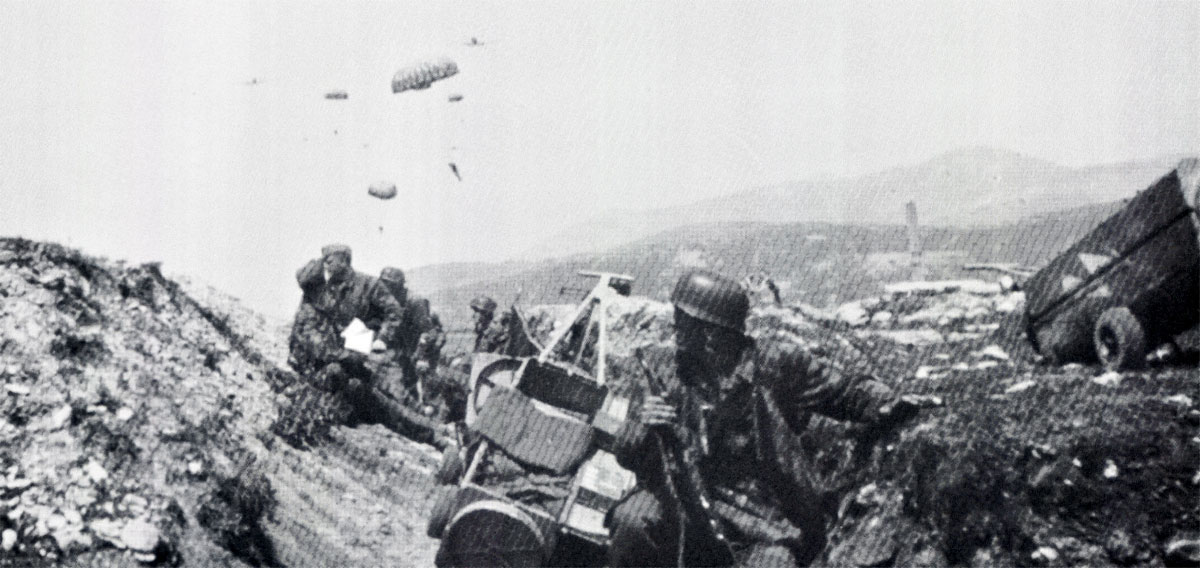
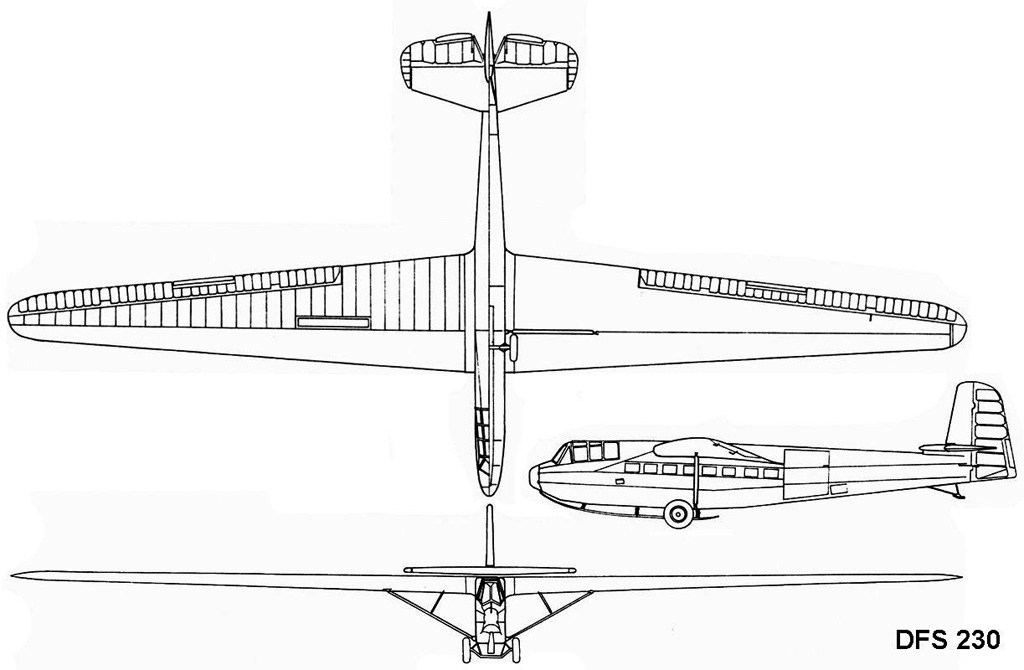
The main transport glider used by the Luftwaffe (German air force) during the invasion of Crete was the DFS-230.

It was designed to carry 10 fully equipped soldiers (including the pilot, who was expected to fight as an infantryman after landing) or a freight load of about 1200 kg.
Seats were arranged in a single line along the centre of the fuselage, six facing forward and four backward. The rear seats could be detached to make more room for equipment and supplies.

With a steel tube body and fabric-covered wings, the 11-m long glider could reach speeds of 160 km per hour at low altitude (300 m). To get it airborne and to the intended landing zone the DFS-230 had to be towed by another aircraft, generally a Junkers Ju 52.
The glider was fixed to a hook in the tail of the aircraft by a rope or a steel cable and deployed via a quick-release mechanism.
During the Second World War DFS-230 gliders were used by the Germans in several high-profile operations, including the assault on Fort Eben-Emael in Belgium, during the Battle for Crete, and during the rescue of Benito Mussolini from prison in Italy.
DFS 230 DIMENSIONS AND SPECIFICATIONS
Length: 11.3 m (37 ft.)
Span: 21.1 m (69 ft. 1 in.)
Wing area: 38.1 sq.m. (410 sq.ft.)
Height: 2.8 m (9 ft. 4 in.)
Empty weight: 770 kg. (1,700 pounds)
Loaded weight: 2,040 kg. (4,500 pounds)
Maximum takeoff weight: 2,100 kg. (4,630 pounds)
Maximum speed: 161 km/h at 300 m. (100 mph at 1000 ft.)
Landing speed: 55-65 km/h (35-40 mph)