
Named after the inhabitants of the northwestern English county of Lancashire, the Avro 691 Lancastrian was a Canadian and British-built derivative of the WWII Lancaster heavy bomber. Designed by Roy Chadwick and powered by four Rolls-Royce Merlin engines, the Avro Lancaster bomber became the principal weapon of the Royal Air Force (RAF) after entering service with Bomber Command in 1942.
The Lancaster was used extensively for nighttime bombing raids
Used extensively for nighttime raids over Europe, the Lancaster had a long unobstructed bomb bay that allowed it to carry some of the Allied power’s largest bombs, including the “bouncing bomb” designed by Barnes Wallis for the attack on the German Ruhr valley dams.
.jpg)
Built simultaneously with the bomber, the Avro Lancastrian was a modified Lancaster bomber without any armor plating and no gun turrets. The Lancastrian was produced by Canada’s Victory Aircraft for civilian transport duties with Trans-Canada Airlines (TCA) and was powered by Packard-built Merlin 38 engines and featured a streamlined nose and tail.
The bomb bay was used to house two extra fuel tanks
The bomb bay of the Lancaster bomber was used to house two 400-gallon fuel tanks giving the aircraft a more extended range and allowing TCA to deploy the plane on its Montreal to Preswick, Scotland route.
Following the end of hostilities in World War Two, the need for civilian transport was apparent. With a glut of aircraft no longer needed by the military available, several types of planes, including the Halifax heavy bomber, were converted for passenger transportation.
In 1945 the British Overseas Aircraft Corporation (BOAC) took delivery of 30 British-built Lancastrians. On a demonstration flight on April 23, 1945, they flew one of them 13,500 miles from London to Auckland, New Zealand. The flight took three days and 14 hours, during which time the Lancastrian flew at an average speed of 220 miles per hour.
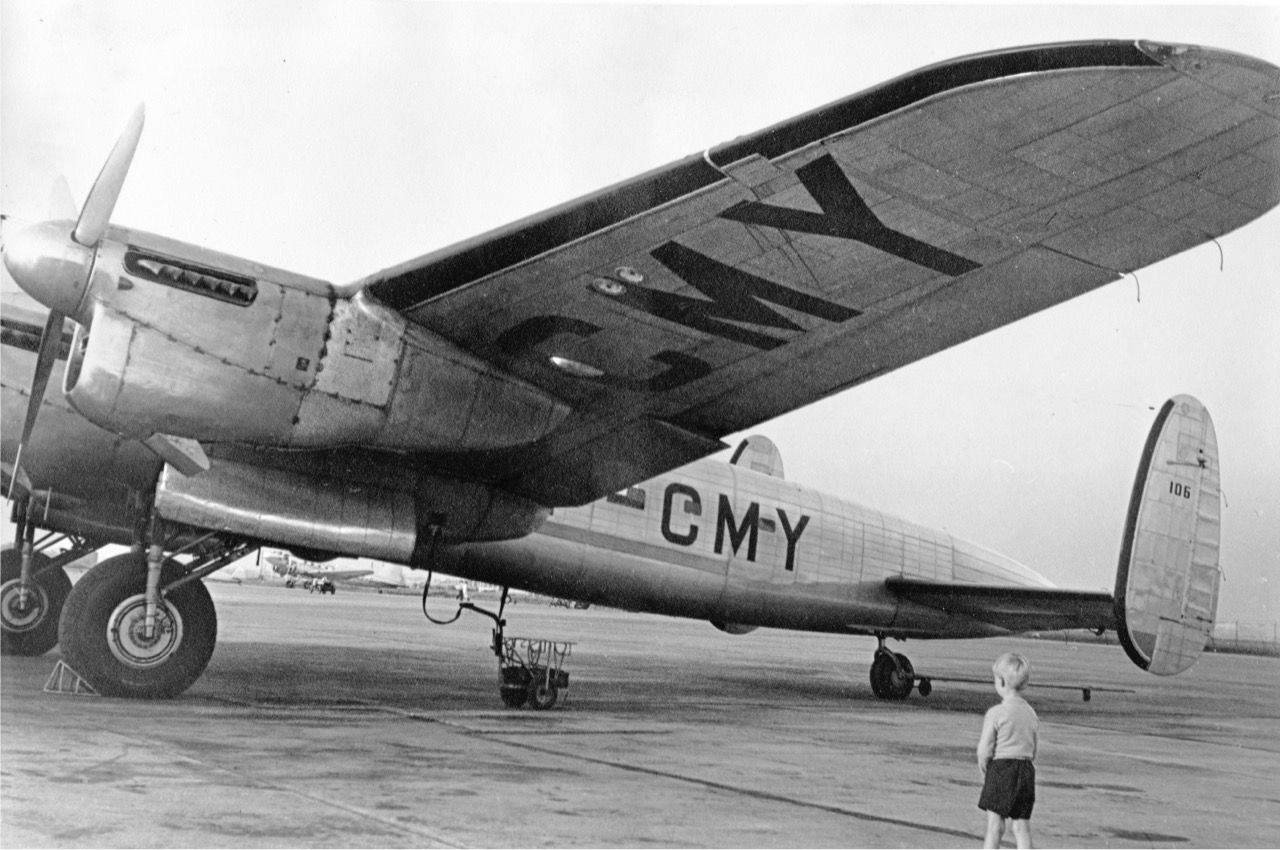
Despite the plane being fast and able to carry heavy payloads, the space inside the aircraft was minimal. When the plane was first built as a bomber, it was designed to have seven crew members dispersed throughout the fuselage, with the main area reserved for carrying bombs. Consequently, it was not suited to carry large numbers of passengers but was ideal as a mail plane and a VIP transport. BOAC deployed its Lancastrians on flights between the United Kingdom and Australia, and the aircraft was also used during the Berlin Airlift to transport fuel and was the first plane to land at the newly opened London Heathrow Airport (LHR) in 1946.
Avro Lancastrian variants
- Lancaster XPP- Nine Lancaster bombers converted by Victory Aircraft Ltd Canada.
- Lancastrian C.1- 23 nine-seat transport aircraft used by BOAC, Qantas, and the RAF
- Lancastrian C.2- 33 nine-seat military transport aircraft used by the RAF
- Lancastrian 3- 18 13-seat transport aircraft built for British South American Airways
- Lancastrian C.4- Eight 13-seat military transports built by Avro for the RAF
During its operational history, between 1946 and 1964, 23 hull loss accidents resulted in 91 fatalities. The most notable occurred on December 11, 1960, when an Argentinian Air Force Lancastrian crash