
History has seen many waves of Egyptomania but, until the 19th century, scholars remained baffled by the many repeated symbols and motifs wrapped around every new find, from majestic monuments to furniture, canopic jars, and fragments of papyrus. This mysterious visual language, known as hieroglyphs, held the key to understanding the secrets of the ancient world but it was impossible to make any sense of.
This was all set to change upon the discovery of the Rosetta Stone in 1799 by members of Napoleon’s military campaign in Egypt. The stele had the same text written in three languages, including hieroglyphs and ancient Greek. Suddenly, the race was on between French linguist Jean-François Champollion and English polymath Thomas Young to use their knowledge of ancient Greek and some creative thinking to decipher the hieroglyphs. Various breakthroughs culminated in Champollion’s “I’ve got it!” moment in 1822.

Once Egyptologists had cracked the code to deciphering hieroglyphs, they were able to enter a world in which great pharaohs waged wars, enacted laws, and journeyed through the afterlife. Papyri receipts and ostraca—stone or pottery fragments bearing inscriptions—even offer an insight into everyday life, from commercial transactions to services offered and personal grudges held.
So how do hieroglyphs work and do you need to be a scholar to start interpreting some of these ancient texts?
Is it a Sound or a Picture?
Classical scholars had tended to assume that hieroglyphs are ideographic, meaning that the motifs are symbols referring to a word or idea. While this is often the case, Champollion’s major 1922 breakthrough was his discovery that hieroglyphs can also be phonetic, meaning they represent sounds like letters in modern alphabets. Sometimes the same hieroglyph can be used as either a sound sign or a picture sign, depending on the context.

Detail of relief at the Temple of Luxor, Egypt. Photo: Prisma / UIG / Getty Images.
There are 24 sounds that can be written using hieroglyphs. A quail chick, for example, denotes an ew or u sound while a rope tether denotes the sound ch. Other signs map more easily onto the Roman alphabet, including a leg for the letter b, a horned viper for f, or an owl for m.
Things get more complicated for signs that denote longer sounds. For example a beetle roughly corresponds to the sound kheper and was often used to write the phrase “to become.” The head and neck of a dog denotes the sound weser and would be used in the word “powerful” or related words.
Overall, Egyptian scribes had to memorize some 750 signs. In cases where one sign denotes a whole word, this was signaled to the reader with a small stroke beneath the sign. A circular motif could mean both “sun” and “day,” with multiple referring to multiple days. The word “god,” meanwhile, was written using one flag-pole, an object that ancient Egyptians would have been used to seeing used to mark a god’s temple.

Detail of the Flaminio Obelisk of Ramses II from Heliopolis, with a duck and son hieroglyph at the center. Photo: PHAS / Universal Images Group via Getty Images.
And like most writers, Egyptian scribes were no strangers to a bit of word play. A word for “duck” sounded similar to the word for “son,” for example, so a picture of a duck might sometimes be used as a sign for “son.” In one example carved into Karnak Temple in Luxor, the pairing of sun and duck motifs refers to “son of the sun god Ra” or “son of Ra,” a common title for Egyptian pharaohs to signal their divine status.
Navigating the Text
Even once ready to pick out some words, looking up at a mass of hieroglyphs can be daunting. Though the signs are usually well-organized into delineated columns, we are not supposed to read them horizontally from left to right, as we do English.
Hieroglyphs are usually read right to left, although this can vary. Thankfully, scribes left clues to guide the reader in the orientation of the motifs. They key is to look at the heads of the human figures and animals, they will always be facing towards the start of the text. Finally, the columns are read downwards, from top to bottom

Detail of mural in the Tomb of Nefertari in the Valley of the Queens, Thebes, showing figures facing the same direction. Photo: DeAgostini / Getty Images.
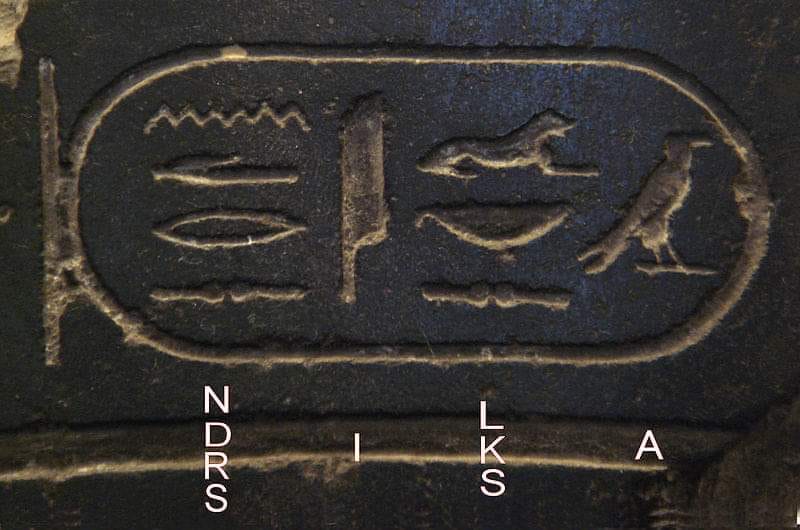
A so-called “cartouche” is an oval-shaped outline framing segments of text, sometimes also marked out by its color. It was used to enclose a royal name, with ancient Egyptians believing that it served as a magic protective barrier around the divine entity, warding of any evil energy.
We can thank the handy cartouche for our ability to interpret hieroglyphs today. When Thomas Young was puzzling over how to read hieroglyphs, it wasn’t even clear where one word ended and another begun, with the exception of words in a cartouche. These devices allowed Young to find the name Ptolemy in both the ancient Greek and Egyptian text and so start assigning phonetic values to those symbols. Champollion would build on this foundation by cross-referencing Ptolemy’s cartouche with another belonging to Cleopatra.

Detail of relief on the Tomb of Thutmose III in the Mortuary Temple of Hatshepsut, Deir el-Bahari, showing hieroglyphs and cartouches. Photo: DeAgostini / Getty Images.
Hieratic Writing
Egyptian artisans took great pride in arranging stylized hieroglyphs in an elegant manner across temples and tombs, either as wall paintings or relief carvings. This kind of care resulted in beautiful imagery befitting of a divine ruler but was costly and impractical for day-to-day matters. Scribes tasked with personal correspondence, legal documents, receipts, or administrative records, developed a version of hieroglyphs that could be quickly scrawled. This cursive writing system, usually produced in ink using a reed brush on papyrus or onto ostraca, was known as hieratic script.
These less formal writings offer a rare insight into daily life for those Egyptians who didn’t inherit royal status and in some cases they record words of fiction. The Story of Sinuhe is known to us from an impressive away of sources: five surviving papyri and 30 ostraca versions. One of ancient Egypt’s greatest literary masterpieces, it follows an official who served prince Senwosret and fled Egypt, is successful in combat against rebellious tripes, and only returns in old age.

Ancient Egyptian hieratic papyrus of a process document. Photo: PHAS / Universal Images Group via Getty Images.
Although the story was very likely made up, its exploration of themes of identity, loyalty, order, and chaos gives us an insight into ancient Egyptian morals and concerns. For example, even though Sinuhe finds success in exile, he abandons it all in order to buried in his homeland.