
Archeologists discover secret chamber inside a 2,600 year old grave
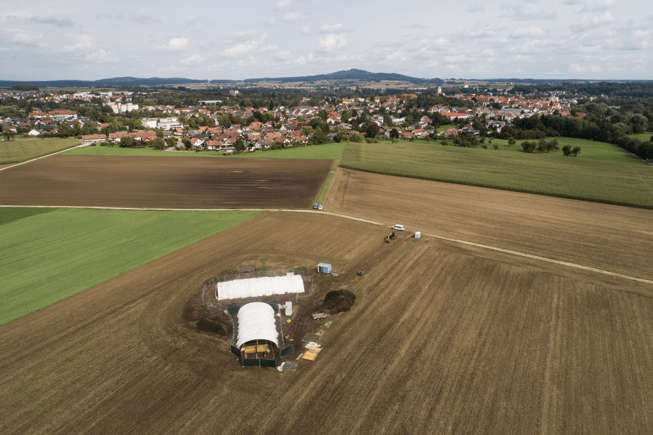
Sitting in the Danube plain near Riedlingen, southwestern Germany, is a 65 meter-diameter burial mound that was once 6 metres high. A burial mound with these dimensions belongs to the small and exclusive group of so-called princely burial mounds used for Celts of high standing. But that is not the most fascinating thing found during the excavation. Researchers also found an incredibly well-preserved wooden chamber buried beneath the mound (Picture: LAD / Andreas Dubslaff)
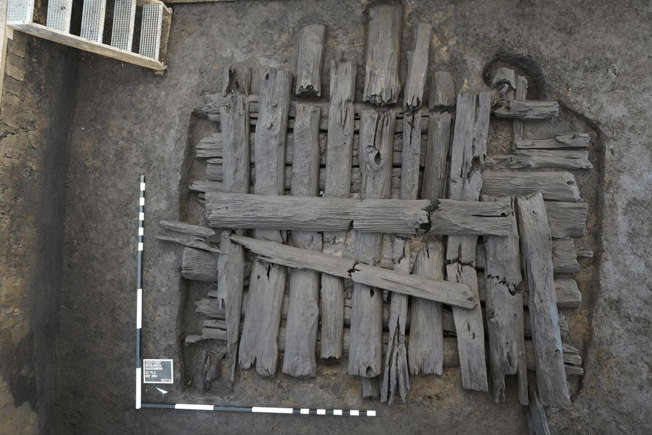
It is thought the mound dates between 620 and 450 BC, and the chamber beneath, known as the Riedlingen chamber grave, was likely completed around around 585 BC. The chamber has a completely preserved ceiling, walls, and floor all made of solid oak, and was tucked away just 70cm below the recent surface. The team revealed this finding as under normal conditions wood in the ground only survives for a few years or decades, but this chamber lasted over 2,000 years (Picture: State Office for Monument Preservation in the Stuttgart Regional Council/Jörn Heimann)

So far, several well-preserved bones of a human skeleton have been recovered from the hidden chamber which researchers think come from a male individual who is probably 15 to 20 years old and between 160 and 168 cm tall.Another skeleton was found close to the surface at the edge of the grave monument, belonging to a 25 to 35 year old man. Goods in this grave included two bronze garment clasps and a small rock crystal, which may have been worn around the neck as an amulet (Picture:State Office for Monument Preservation in the Stuttgart Regional Council / Faber Courtial)
State Secretary Andrea Lindlohr MdL said: ‘The newly discovered burial chamber is an outstanding testimony to our rich monument landscape. It is still completely intact 2,600 years after it was created. The archaeological heritage of Baden-Württemberg is impressive and gives us insights into times and societies long past’ (Picture: State Office for Monument Preservation in the Stuttgart Regional Council / Quentin Sueur)
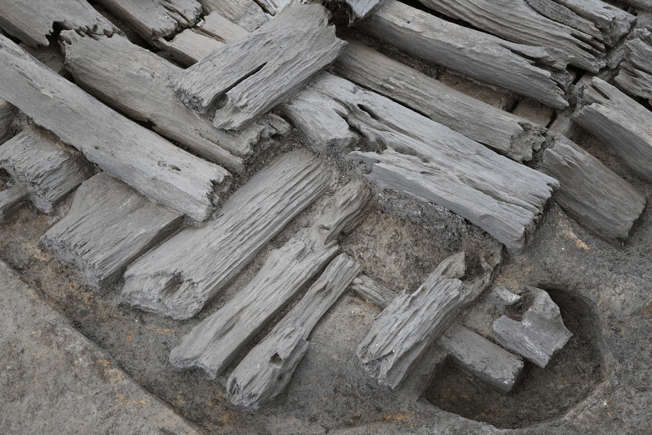
It’s thought the damp conditions of the site’s soil prevented oxygen from getting to the wood which led to its state of preservation. The chamber is around 3m wide and 4m long. The floor features strong planks laid north-to-south, and the walls are made of upright planks that cross at the corners. A crossbeam in the middle and top of the walls supported the heavy ceiling before, at some point, it collapsed under the weight of the mound (Picture: State Office for Monument Preservation in the Stuttgart Regional Council / Faber Courtial)

It was thought the thickness of the ceiling was to stop grave robbers. However, archaeologists located two robber tunnels which led to the southeast corner of the chamber where thieves broke through the chamber ceiling and gained access through a small entry hole. The theft must have been extensive as recent excavation located no metal or valuable materials inside the chamber suggesting there was a lot of valuable ornaments to steal(Picture: State Office for Monument Preservation in the Stuttgart Regional Council / Faber Courtial)

But despite the theft, the find is still exciting for those involved. Professor Dirk Krausse, lead state archeologist, said: ‘The Riedlingen grave is a stroke of luck for archaeology: the scientific significance of this modernly examined and completely preserved Celtic chamber grave extends far beyond the borders of Baden-Württemberg and southern Germany’ (Picture: State Office for Monument Preservation in the Stuttgart Regional Council / Yvonne Mühleis)

A completely preserved Celtic burial chamber has only been discovered once in Germany, in 1890 near Villingen in the Black Forest. However, at the time because it was poorly documented, it was only partially persevered (Picture: State Office for Monument Preservation in the Stuttgart Regional Council / Jörn Heimann)
Excavations will continue over the coming weeks, and should be completed this year. Dr. Roberto Tarpini (LAD), who is leading the excavations on site, said: ‘The investigations and analyses that will be carried out after the excavations have been completed will lead to further important findings, particularly on the question of who this monumental burial mound was built for’ (Picture: State Office for Monument Preservation in the Stuttgart Regional Council / Jörn Heimann)
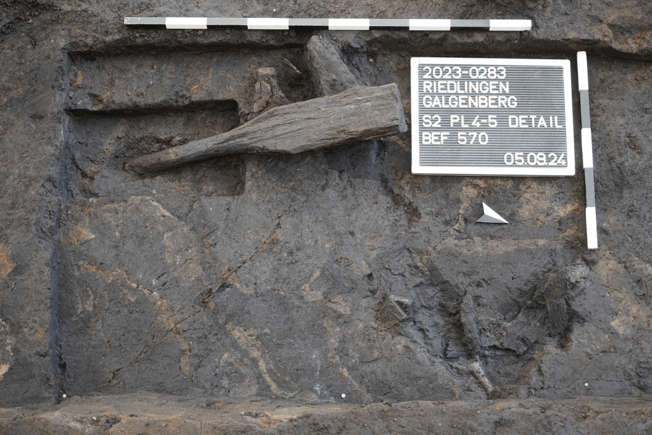
The team also found a ‘club-like’ wooden artefact that the Celtic builders left behind after the construction of the chamber. Near the burial mound there were also a small pit with two clay vessels that contained human cremated remains (Picture: State Office for Monument Preservation in the Stuttgart Regional Council / Jörn Heimann)