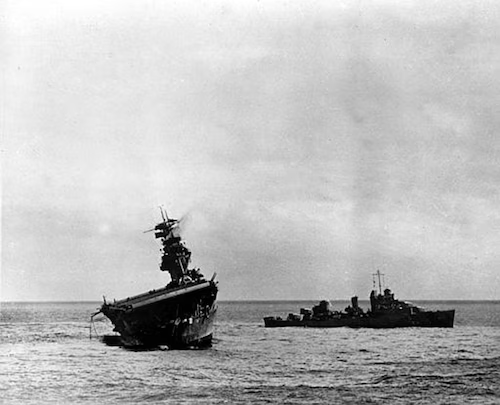
On June 4, 1942, just six months after the Japanese attack on Pearl Harbor, the Battle of Midway began during World War II.
The battle lasted through June 7. In the end seven ships sunk and 3,364 men died.
Military historian John Keegan called the Battle of Midway “the most stunning and decisive blow in the history of naval warfare.”
The Patriot reported on June 5, 1942, “Japanese planes attacked tiny Midway Island and its tough Marine Corps garrison again today, while far to the north Dutch Harbor, which was raised by enemy bombers yesterday, reported that all was quiet.
The Navy made public only a bare announcement that the enemy planes struck at the stubbornly held mid-Pacific atoll of Midway at 9 a.m. local time (2:30 p.m. E., W., T.). Details of fighting were lacking.”
On Saturday, June 6, the paper reported, “A great air and naval battle, possibly with the possession of Midway Island at stake, presumably was in progress today off the low-lying outpost northwest of Hawaii, following an attempt in force by the Japanese yesterday to raid the strongly-fortified base.
The enemy ran into a hot reception, said a communique by Admiral Chester N. Nimitz, commander-in-chief of the Pacific Fleet, and suffered direct hits on at least one battleship, an airplane carrier and possibly other warships. In addition, the defense forces took a heavy toll of attacking warplanes.
Midway’s defenders continued the attacks on the enemy, Admiral Nimitz said, leading to comment by naval experts in Washington that the ensuing engagement may have been one of the greatest battles of the war in the Pacific so far.”

On June 8, The Patriot reported that the Japanese “struggled desperately … to escape total destruction by victorious United States forces reported inflicting growing losses on the enemy in the fourth day of a running battle.
At least thirteen to fifteen of the Japanese vessels, including aircraft carriers, battleships, cruisers and transports, already had been sunk or damaged in the colossal engagement west of Midway Island. But indications were that the enemy’s losses were climbing to even greater proportions as American warships and planes relentlessly pressed mopping up action.
The pursuing United States forces, whose losses were insignificant compared to those of the foe, were believed fully exploiting their advantage to deal smashing new blows at the surviving units of the retreating Japanese formations.
The triumphant American naval and air units, having already decided the issue by crushing a Japanese drive for Midway, were believed to be still blasting doggedly
On June 11, The Patriot reported that the battle was over.
“The battle of Midway moved so rapidly that the final returns still are not scored. It ended, for the time being at least, Saturday night when pursuing American forces lost the Japanese fleet remnants in the darkness.
Until the final accounting the score, as reported by Admiral Nimitz, stands at two and perhaps three Japanese aircraft carriers sunk, with all of their planes; one destroyer sunk and three battleships and eight to eleven other ships damaged, three of them transports and the other warships.
Nimitz reported the loss of one American destroyer, damage to one United States aircraft carrier and the loss of an undisclosed number of planes.
(The Japanese have admitted the loss of one aircraft carrier, damage to another carrier and a cruiser, and 35 planes missing. In turn, they asserted they had sunk two 19,000-ton American aircraft carriers, one transport and shot down 135 United States planes.)”