
As if we weren’t excited enough for the long-delayed full unveiling of Giza’s Grand Egyptian Museum (GEM) in July, the institution has just announced that it has received another 163 artifacts from the tomb of King Tutankhamun, bringing the museum one step closer to staging the first-ever complete display of the legendary boy king’s golden treasures.
This is the just the latest delivery of objects from the Egyptian Museum in Cairo’s Tahrir Square, announced by the Egyptian Ministery of Tourism and Antiquities. They were transported with the greatest of care, with a thorough condition report conducted upon arrival to GEM’s state-of-the-art conservation laboratories.
“The arrival of these remarkable treasures heralds the final phase of preparations ahead of the Grand Egyptian Museum’s official inauguration,” the Minister of Tourism and Antiquities, Sherif Fathi, told the Egyptian Gazette.
More King Tut artifacts will be making their way to Giza in the coming weeks as the museum, which has cost over $1 billion to build, gets ready for the grand opening on July 3.

One of the King Tut artifacts transferred to the Grand Egyptian Museum in Giza. Photo: courtesy of the Egyptian Ministery of Tourism and Antiquities.
The last piece to make the journey will be his instantly identifiable funerary mask, according to the Egyptian Museum website.
Ahead of GEM’s opening, the conservation team will complete any necessary restoration work on the antiquities, which date to the late 18th Dynasty (ca. 1332–1323 BCE), museum CEO Ahmed Ghoneim told the Egypt Independent.

One of the King Tut artifacts transferred to the Grand Egyptian Museum in Giza. Photo: courtesy of the Egyptian Ministery of Tourism and Antiquities.
Archaeologist Howard Carter discovered King Tut’s final resting place in 1922, and its treasures are famed the world over. (Earlier this year, the suitcase Carter used in his travels to Egypt sold at auction for the equivalent of roughly $15,000.)
The latest batch of King Tut artifacts to arrive at GEM includes the pharaoh’s ceremonial chair, a particularly ornate piece inlaid with ivory, ebony, faience, and gold. The symbol of the sun disk emblazons the chair’s backrest, above the outstretched wings of the vulture goddess Nekhbet.

King Tut’s ceremonial chair, one of the artifacts transferred to the Grand Egyptian Museum in Giza. Photo: courtesy of the Egyptian Ministery of Tourism and Antiquities.
Demonstrating the pharaoh’s power, the gilded footstool is decorated with nine panels depicting Egypt’s traditional enemies, the Nubians, the Libyans, the Asiatic, the Sea People, the Assyrians, the Hittites, the people of Kush, the Babylonians, and the Palestinians.
The delivery also featured the gilded wooden shrine that stored King Tut’s canopic jars, as well as gold, carnelian, and agate necklaces and other jewelry.
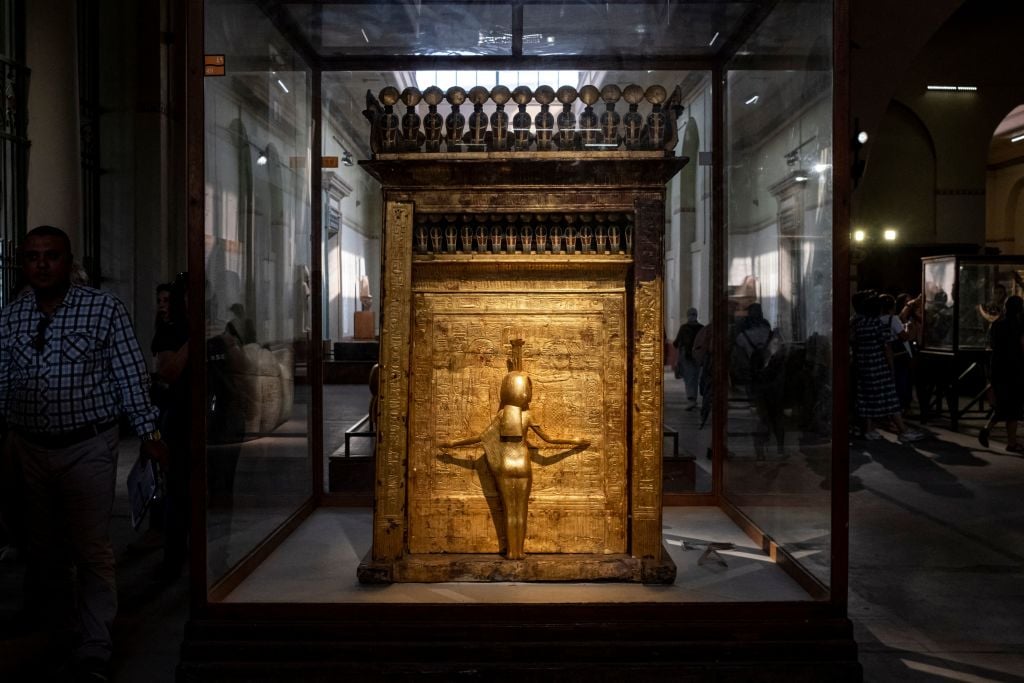
Pharaoh Tutankhamun’s Canopic Shrine. Photo: Amir Makar/AFP via Getty Images.
GEM has been in the works since 2002, with the opening originally planned for way back in 2012. We included the museum on our list of the “Biggest, Baddest, Boldest Museum Openings in 2018”—another date that came and went. Then, we were fully expecting a 2020 debut, which didn’t happen for obvious reasons.
But the delays persisted even after lockdown ended, with the first stage of the soft opening not taking place until November 2023, with the unveiling of the grand staircase, a 6,500-square-foot space filled with large statues such as the 3,200-year-old statue of Ramses II so colossal the museum had to be constructed around it. (It was excavated in pieces in 1820 and had been on display in Cairo’s Ramses Square since 1955.)

A view of the main atrium with a statue of Ramses II as people visit the Great Egyptian Museum. Photo by Mohamed Elshahed/Anadolu via Getty Images.
The museum opened up a further 12 exhibition halls in October 2024. But as impressive as GEM already is, the true star of the show, King Tut’s collection, won’t be on view until the final ribbon cutting.
The Egyptian Museum has housed the collection in its Beaux Arts-style building since its opening in 1902. But the facilities haven’t been modernized, and there was a high-profile conservation snafu over a decade ago. Reportedly, museum workers accidentally snapped off the braided beard on King Tut’s funerary mask, and hastily repaired it with some kind of epoxy, leaving visible damage. (Eight employees were charged with negligence.)
Not only are GEM’s facilities state of the art, the museum’s galleries, they have the space to showcase all 5,398 items from Tut’s tomb—far more than the 2,000 on display at the Egyptian Museum.

One of the King Tut artifacts transferred to the Grand Egyptian Museum in Giza. Photo: courtesy of the Egyptian Ministery of Tourism and Antiquities.
A handful of other King Tut treasures are coming to GEM courtesy of the Luxor Museum. The transfers have been going on since at least 2018. By that point, 4,800 of the boy king’s funerary goods were already on site at the under-construction museum. That year, GEM held a ceremony for the arrival of King Tut’s chariot, previously displayed at the National Military Museum in Cairo.
Even more dramatic was the transfer of 22 ancient Egyptian royal mummies from the Egyptian Museum to the new National Museum of Egyptian Civilization to mark the latter’s opening in 2021. The museum staged an elaborate procession across the city, with the mummies stored in oxygen-free nitrogen capsules in golden vehicles designed to look like ancient pharaonic boats.